

Bird News from Nial Moores, with Hong Sung Min, Kim Dong Gyu, Kim Eojin, Andy Lee and many others!
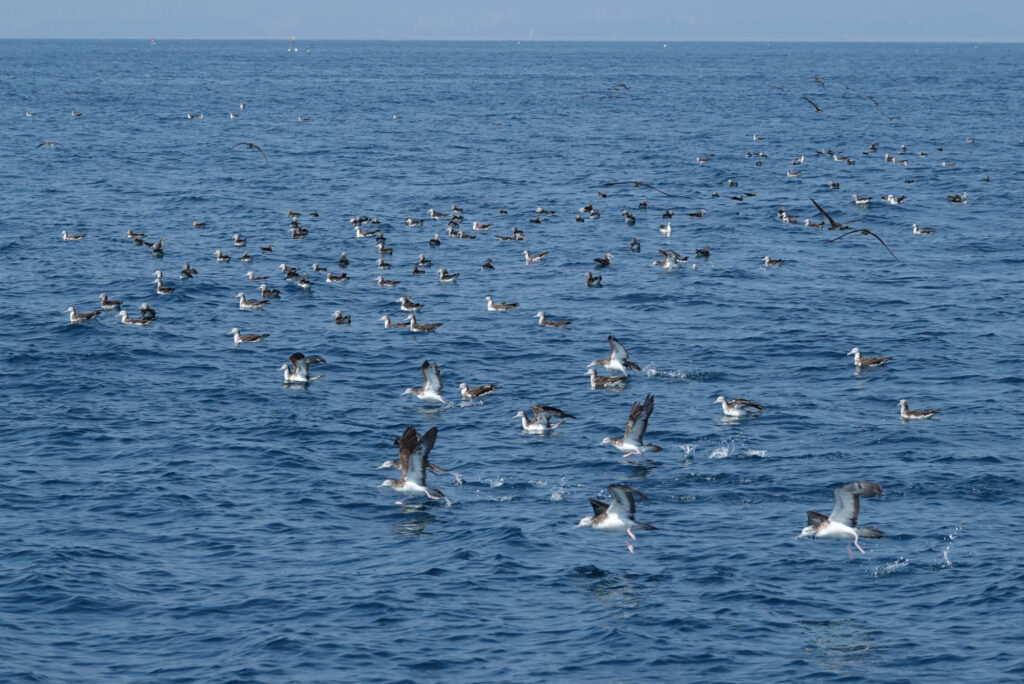
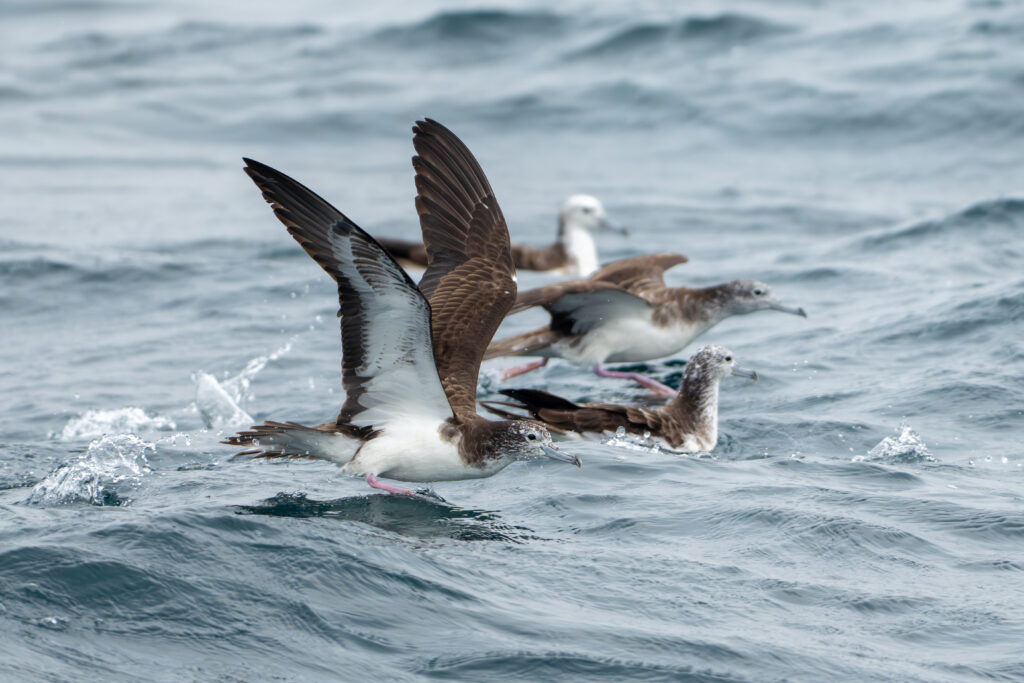
For me personally, a really interesting start to autumn seawatching, with a three-hour boat trip out from the Gurypongpo Peninsula near Pohang on both August 2nd and 3rd, and highlights that included Flesh-footed Shearwater, Long-tailed Jaeger, (Japanese) Crested Murrelet, and really fabulous views of thousands of Streaked Shearwaters.
As written in our Status of Birds back in 2014, “Marine Habitat has an area more than four times greater than all the other main habitat types combined in the ROK. It is also the most poorly-surveyed…with many information gaps” (Moores et al. 2014). Most of our knowledge of seabirds in the ROK still comes from surveys of breeding colonies, or from opportunistic land-based counts (especially in the southeast, from the Guryongpo Peninsula, Ulsan and Busan). Whether due to the finding of two albatross species in Korean waters in the last couple of years, and / or the recognition that it is quite easy to see (and even photograph) Aleutian Tern in Korean waters, and / or the influence of seabird videos by 새덕후 Korean Birder Kim Eojin, happily more and more birders have recently started taking boats out to look for seabirds, especially it seems in August and September and again in mid-winter.
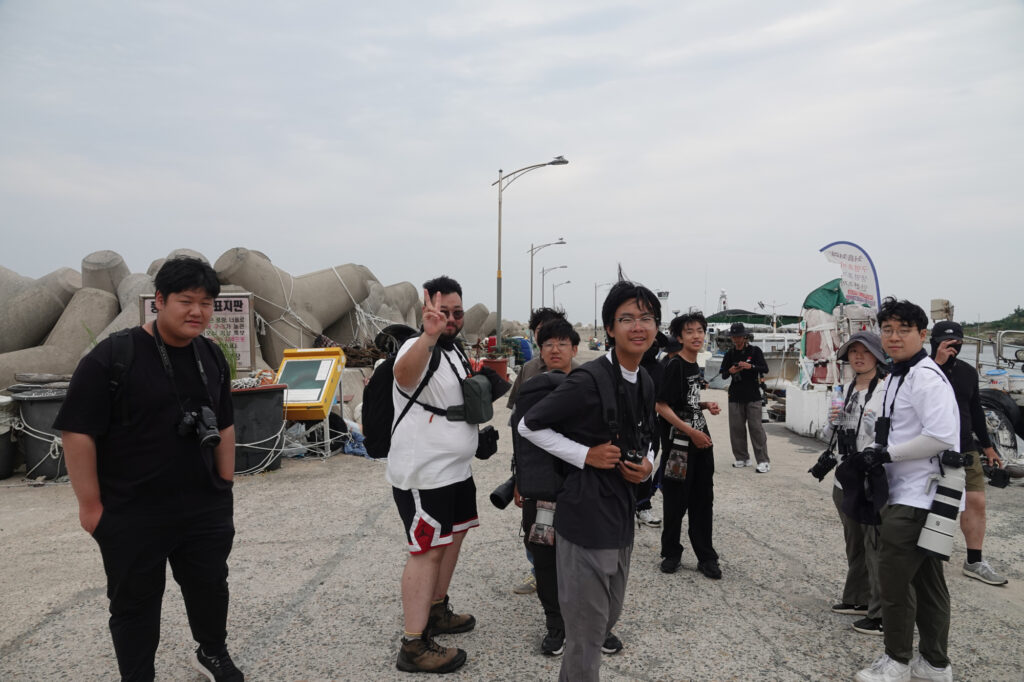
At the kind invitation of Hong Sung Min, I therefore joined a group of young and upcoming birders on a boat organized out from the Guryongpo Peninsula by Kim Dong Gyu on the early season dates of August 2nd and 3rd.
On August 2nd, under clear skies with calm seas and land-based temperatures peaking in Pohang at 37C and sea surface temperatures of 28C (according to the Windy App), it took less than 20 minutes to reach a large raft of globally Near Threatened Streaked Shearwater. This first raft included a lone globally Near Threatened Flesh-footed Shearwater.
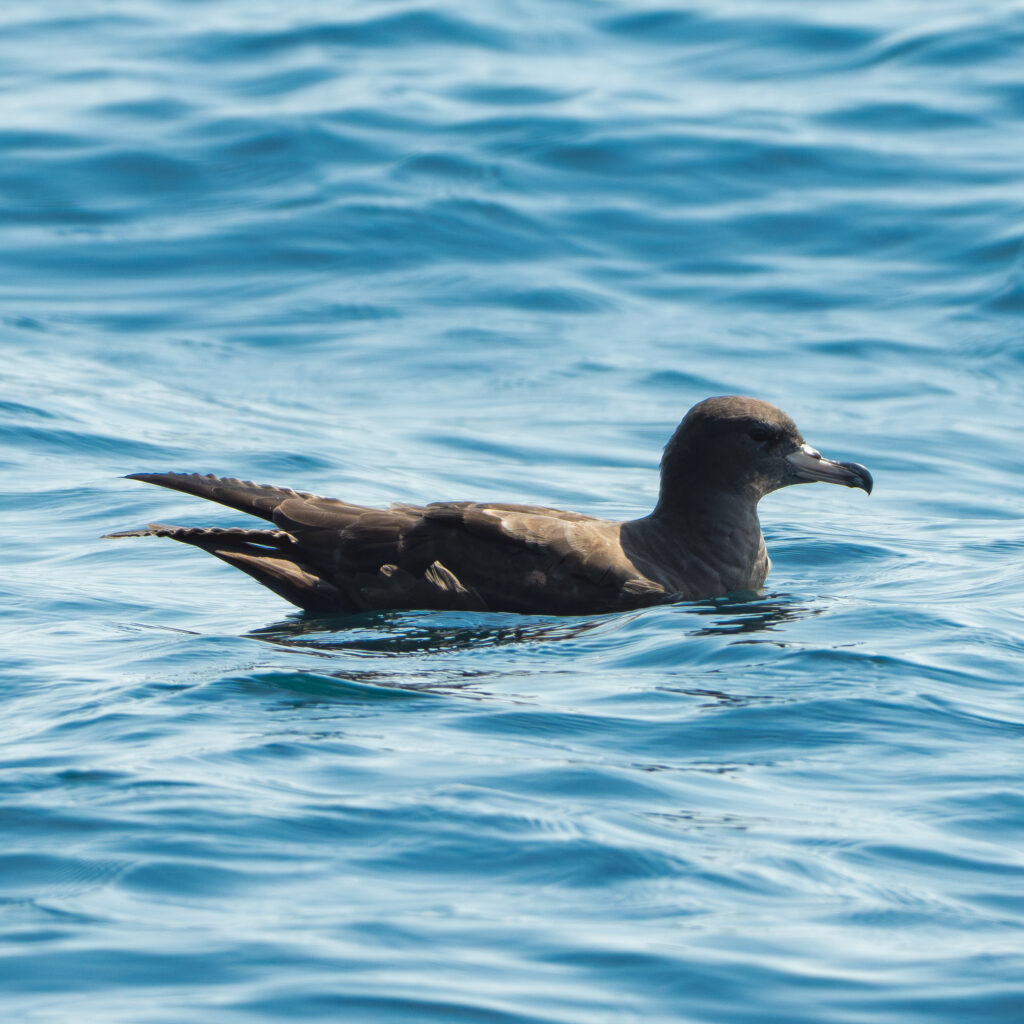
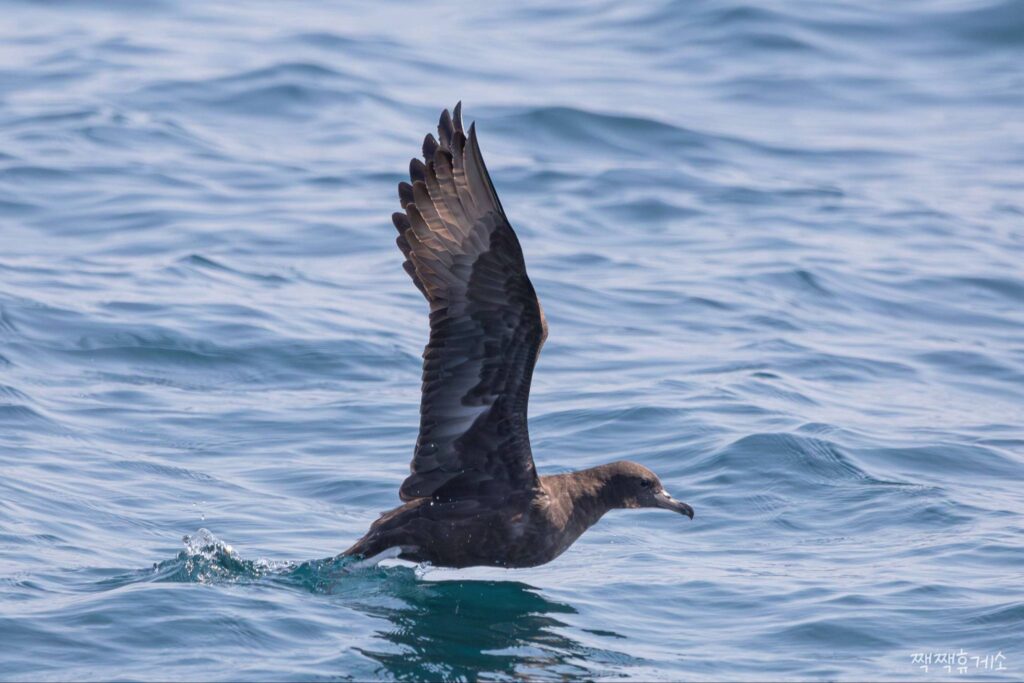
Flesh-footed Shearwater used to be rather more frequent in Korean waters, with annual records in the 2000s from ferries in the West Sea and from land along the east coast, in spite of the much lower number of observers at that time. Records seemed mostly to be from late May or June to mid-October, with e.g., 10 seen off the Guryongpo Peninsula on October 19th 2002 by Arnoud van den Berg and Magnus Robb and five seen between Gunsan and Eocheong on October 18th 2008. Indeed, several decades ago the East Sea was identified as the “main wintering area” for Flesh-footed Shearwater banded on Lord Howe Island off Eastern Australia during the breeding season, with recoveries of banded (presumably dead, trapped in nets) birds from March to September (Purchase 1971). Subsequently, however, the breeding population on Lord Howe Island, “held an estimated c. 20,000–40,000 breeding pairs in 1978, revised to 17,462 breeding pairs in 2003, when burrow occupancy was calculated at 58%; more recently, in 2009, population was estimated to be 16,267 pairs, representing a decline in the number of pairs since the previous count of 6·8% (c. 1·3% per year)” (Carboneras et al. 2020).
Is Flesh-footed Shearwater still a regularly-occurring species in ROK waters (defined by Birds Korea as being recorded ten or more times every year for the past five years)? Or has this species already effectively become lost?
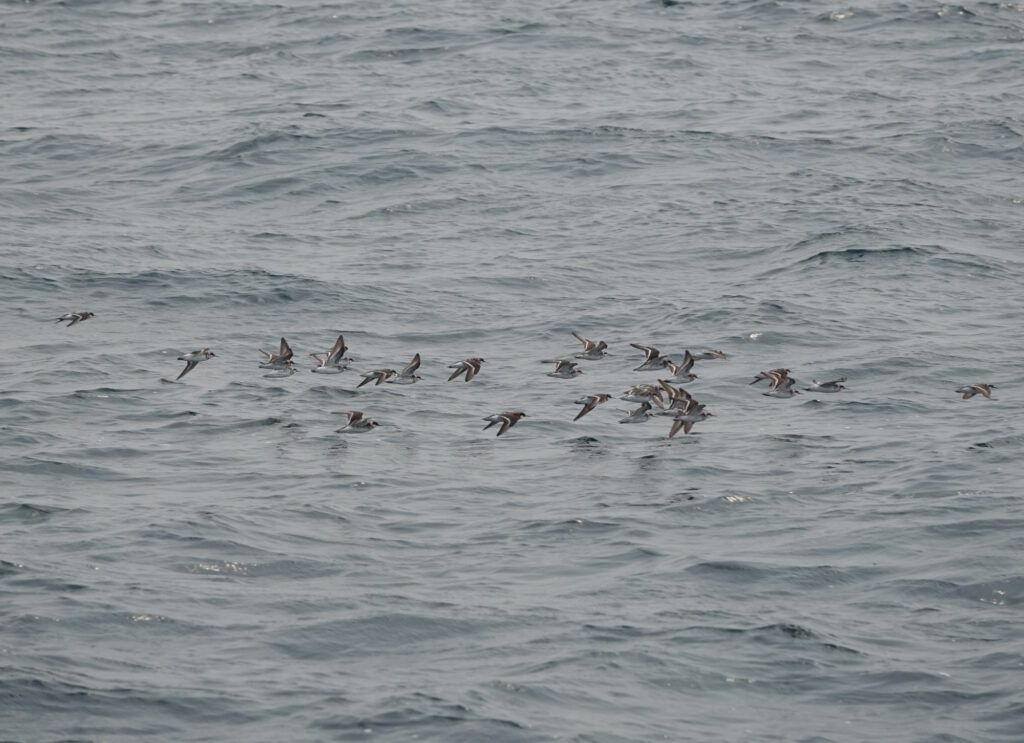
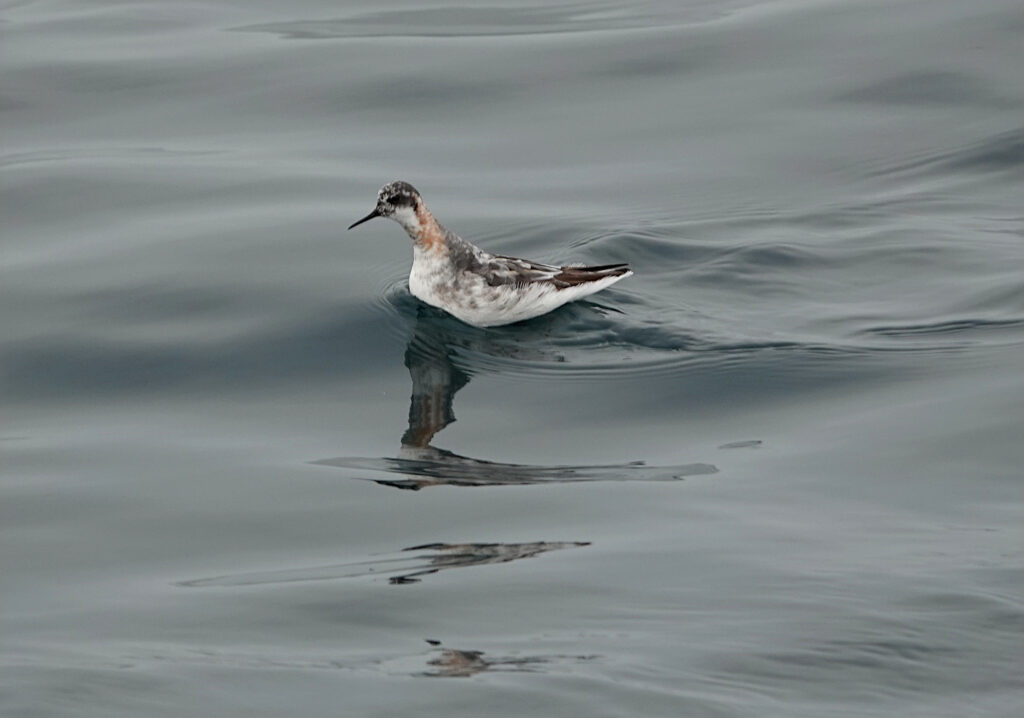
Other species of note included several small groups of Red-necked Phalarope and three storm petrels.
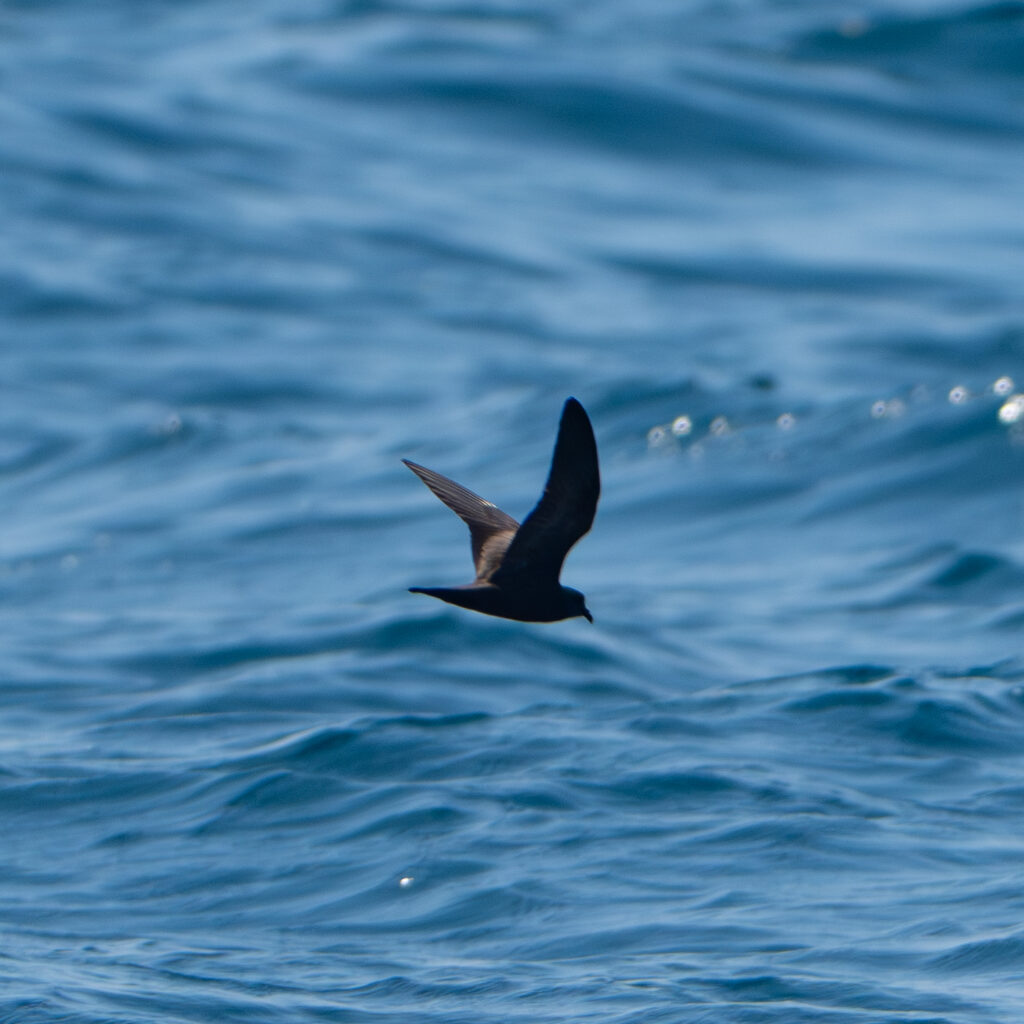
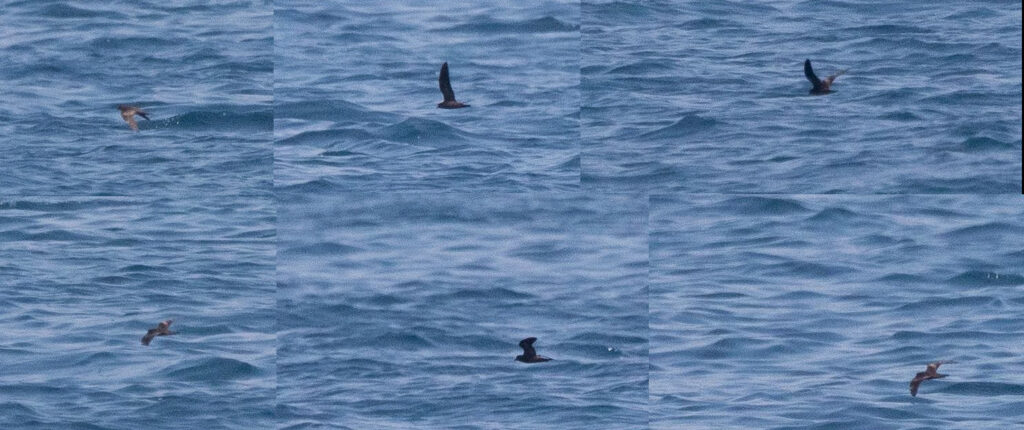
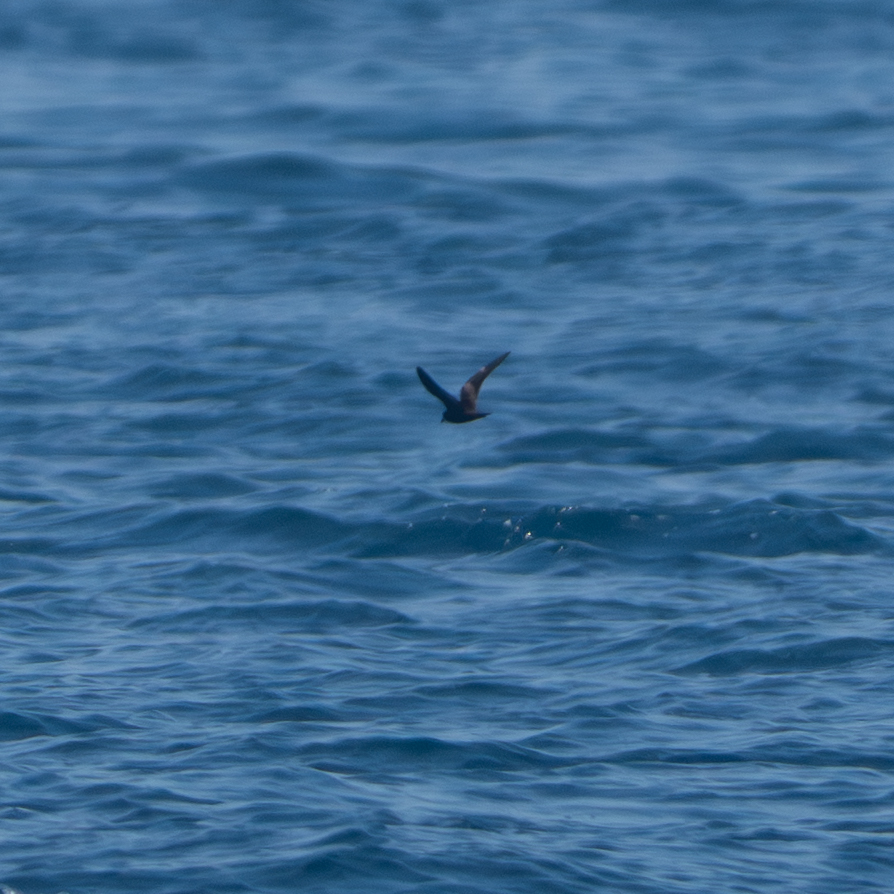
Although the second and third petrel were easy to identify with confidence as Swinhoe’s Storm Petrel, based on their small size, compact look and active flight action (sometimes bat-like, sometimes pratincole like), the first individual in the field gave the impression of being rather large and obviously long-tailed – with angled wings swept back like a falcon, and the flight quite deliberate, powerful and steady (indeed the silhouette and flight action initially strongly suggested ID as a Eurasian Hobby Falco subbuteo 새호리기!).
A series of images of this first individual were taken by Hong Sung Min and Kim Dong Gyu and are kindly shared below. They show that the bird had a fairly obvious white spot at the base of the primary coverts, confidently ruling out the rarely-recorded Bulwer’s. However, how to rule out the still-unrecorded-in-Korea Matsudeira’s Storm Petrel Hydrobates matsudairae? I have seen Matsudeira’s only once (several decades ago, in Japanese waters). Based on that “experience” and the text in Harrison et al. (2021), the flight action and silhouette seemed good for Matsudeira’s, but presumably the white patch would show even more obviously than shown by this bird?
eBird checklist is here.
On the 3rd, in largely overcast conditions with reduced visibility, “Team Ulsan” visited the Homigot area briefly before the boat, finding a small flock of Russet Sparrow, and evidence of some movement – with a flock of ten Common Tern passing by.
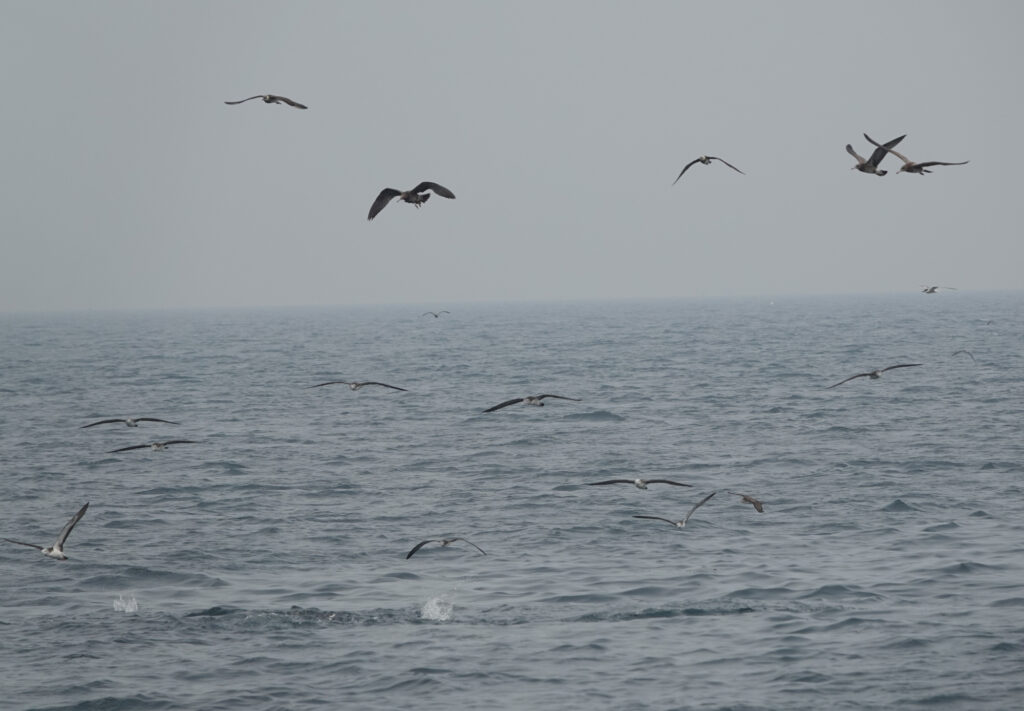
Although only a day later, the seabirding felt rather different. First highlight was a mix of birds (Streaked Shearwaters, Black-tailed Gulls and Common Terns) attracted to a shoal of large fish, identified in the field as Japanese Mackerel, which were pushing smaller fish up to the surface.
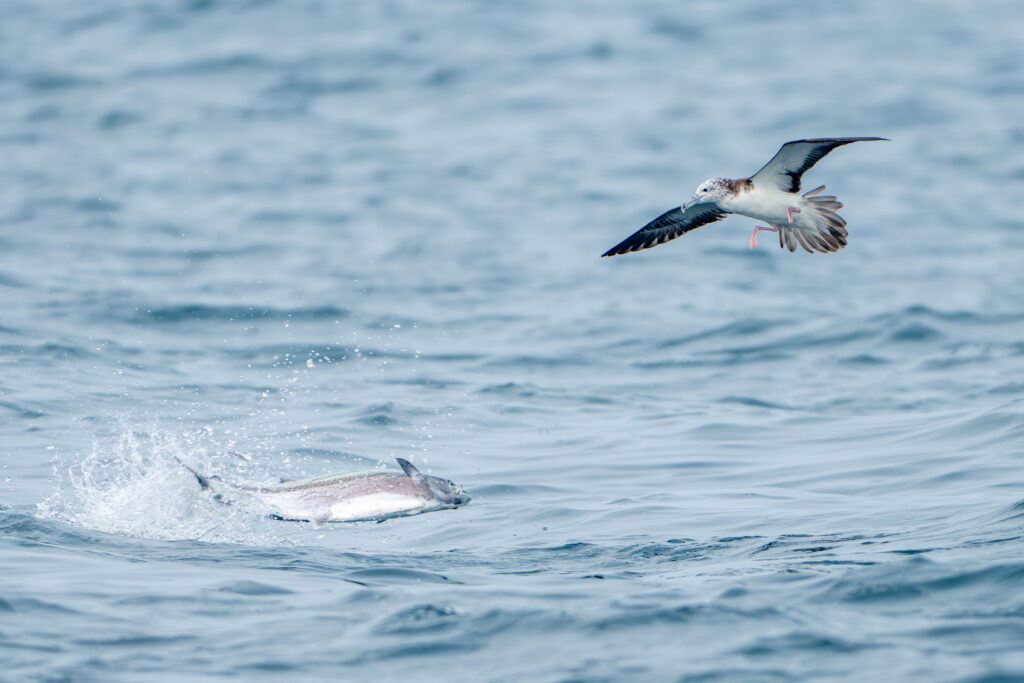
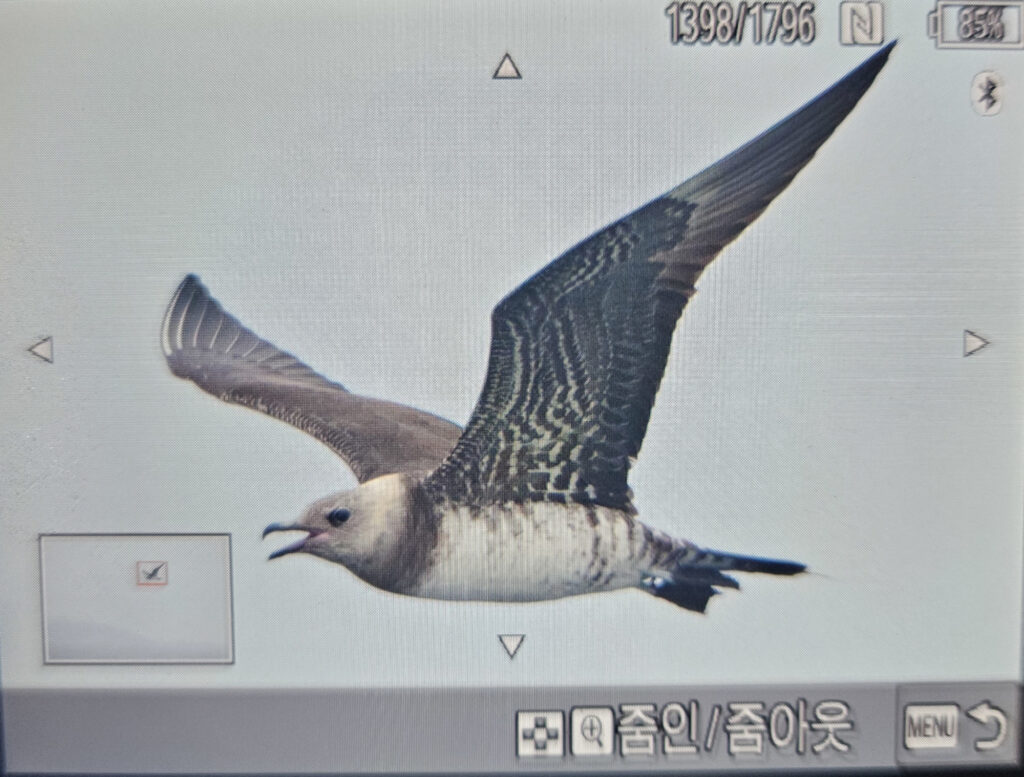
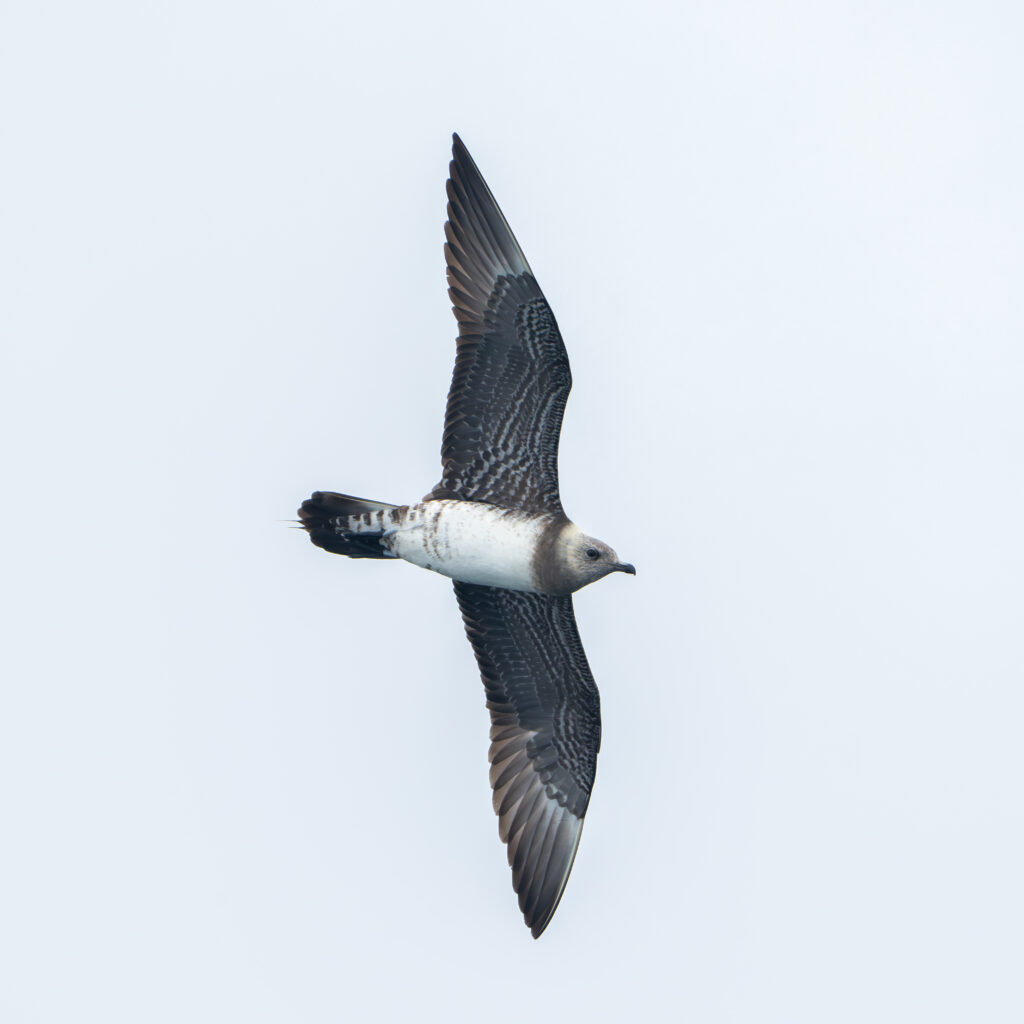
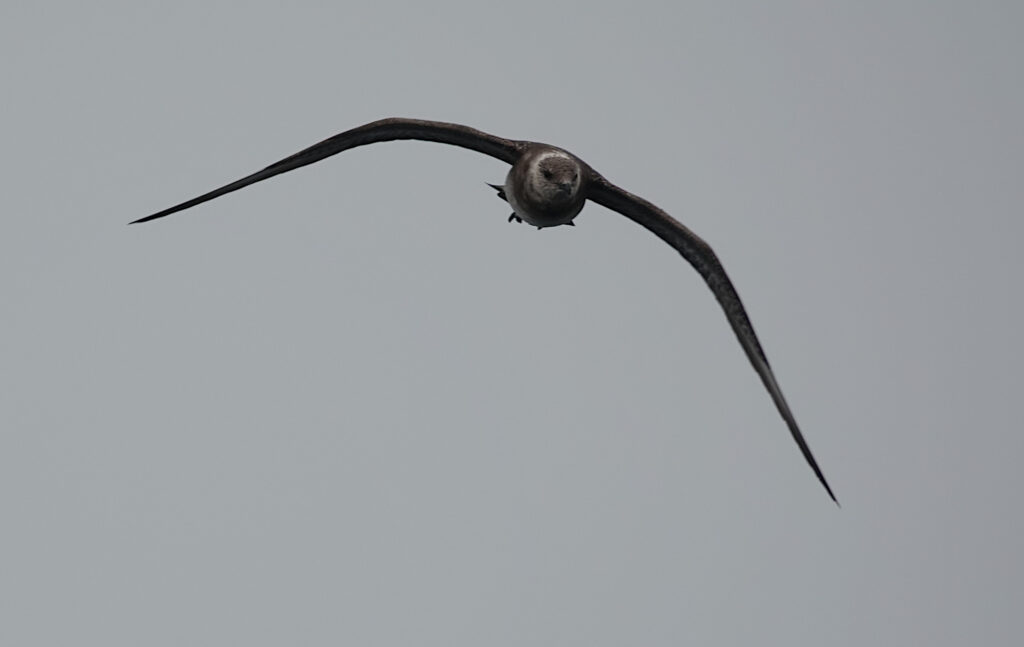
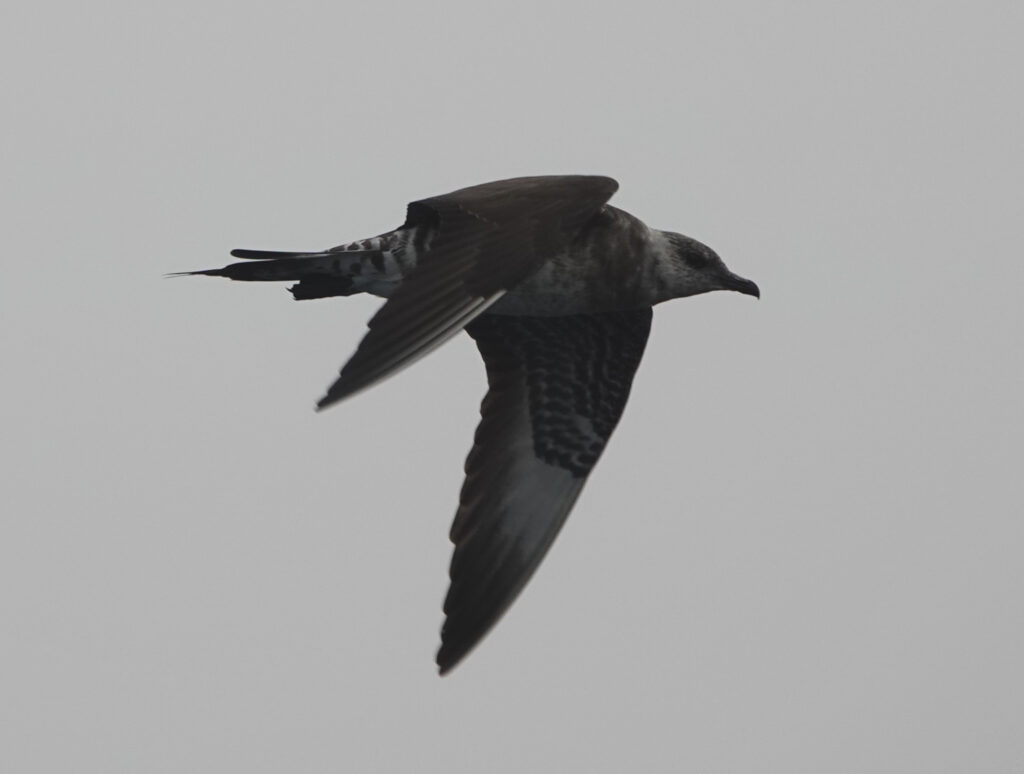
This small feeding frenzy in turn attracted what we identified as one (or much less likely two) immature Long-tailed Jaeger, and one (or perhaps two) immature Parasitic Jaeger.
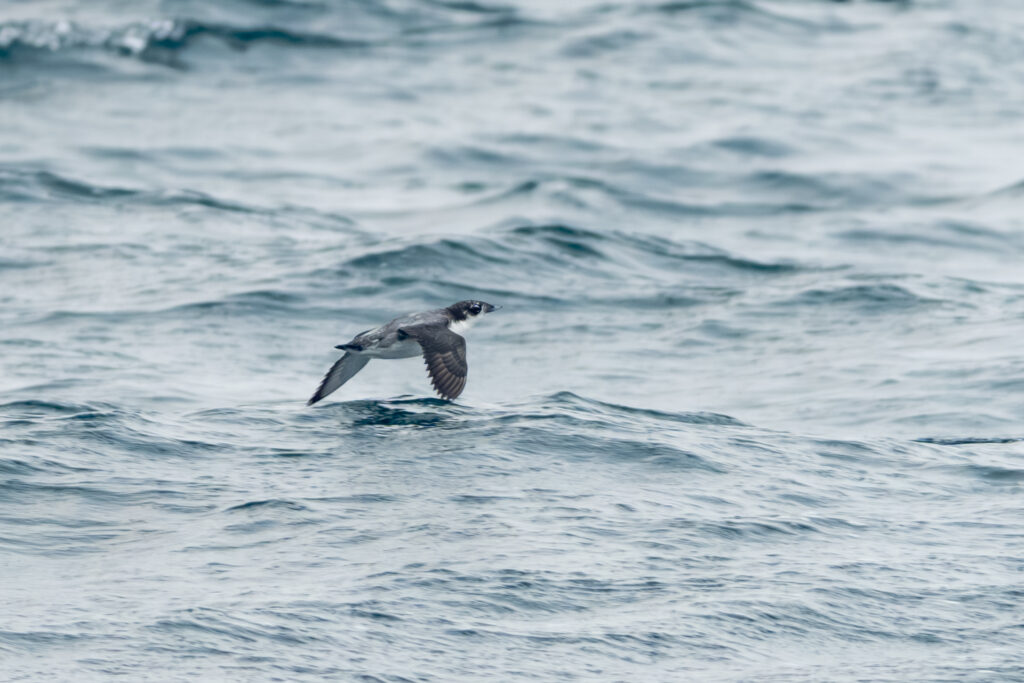
Personal highlight – and a rather easier ID – came when three different globally Vulnerable (Japanese) Crested Murrelets were called out. This becomes my tenth (!) species of alcid seen off this peninsula.
The full checklist is here.
Many information gaps on seabirds at sea remain – and these seem vital to fill properly, especially if the nation is to establish a proper baseline on abundance and distribution before further construction of offshore windfarms in the East Sea is approved, including in waters off Ulsan.
Again thank you for the invitation to join these two boat trips: I very much look forward to going again, especially at the peak of Aleutian Tern migration in late August-early September (with the hope finally of getting decent images of an accompanying Arctic Tern!), or after the passage of a typhoon – when species like the still unrecorded Black-naped Tern Sterna sumatrana and Wedge-tailed Shearwater Ardenna pacifica and Leach’s Petrel Hydrobates leucorhous must all be possible…
References
Carboneras, C., F. Jutglar, G. M. Kirwan, and C. J. Sharpe. 2020. Flesh-footed Shearwater (Ardenna carneipes), version 1.0. In Birds of the World (J. del Hoyo, A. Elliott, J. Sargatal, D. A. Christie, and E. de Juana, Editors). Cornell Lab of Ornithology, Ithaca, NY, USA. https://doi.org/10.2173/bow.flfshe.01
Harrison, P., Perrow, M. R. & Larsson, H. 2021. Seabirds. The New Identification Guide. Lynx Edicions, Barcelona.
Moores, N., Kim, A. & Kim R. 2014. Status of Birds, 2014. Birds Korea report on Bird Population Trends and Conservation Status in the Republic of Korea. Published by Birds Korea, September 2014.
Purchase, D. 1971. Sixteenth Annual Report of the Australian Bird-banding Scheme, July 1969 to June 1970. Division of Wildlife Research Technical Paper No. 22, CSIRO, Australia 1971.