
Professor Martin Perrow, July 2026
By way of introduction, I am Professor Martin Perrow of University College London, as well as a Visiting Scientist with the seabird team at the UK Centre for Hydrology & Ecology; both honorary titles bestowed as a result of my contribution to ecology in the form of some 130 scientific publications and 7 books, largely during my 30-year career as a professional ecologist directing one of the foremost ecological consultancies in the UK. Some of my proudest achievements relate to the successful restoration of wetlands and working to understand the effects of wind farms on seabirds, especially terns. My Wildlife and Wind Farms, Conflicts and Solutions bookseries (Perrow 2017 ab; Perrow 2019ab) documents some of this ground-breaking research over the last 20 years.
As part of this work, my team and I developed a number of innovative approaches to aid the understanding of the interactions between seabirds and wind farms including ‘visual tracking’ whereby a high-speed rigid-hulled inflatable boat is used to follow (from 100 m or so) and observe individual terns at sea on foraging trips after they had left their colonies (Perrow et al. 2011, 2017, 2019) or encountered wind farms (Harwood et al. 2017; Jones et al. 2025). This became a non-invasive alternative to attaching tags to birds, which can have detrimental effects especially on lightweight species such as terns (see Thaxter & Perrow 2019), that need all their aerial mastery to efficiently catch prey and deliver it to waiting chicks. A key advantage of the technique is that all behaviours can be seen and fixed by GPS, alongside all information on foraging attempts and the type and size of any prey captured, which, with established length to weight relationships, can be used to estimate the biomass of prey consumed or carried to chicks. The differences between the often small, low calorie ‘junk’ prey consumed by adults to fuel their foraging trips and the high calorie, lipid-rich fish that dominate chick diet are typically striking.

Visual tracking was adopted as a standard technique to help Government agencies establish at-sea marine protected areas encompassing important grounds adjacent to already protected internationally important colonies (Wilson et al. 2014; Caldow et al. 2020). We have tracked all 5 UK & Ireland breeding species including Sandwich Thalasseus sandvicensis, Little Sternula albifrons 쇠제비갈매기, Common Sterna hirundo 제비갈매기, Arctic Sterna paradisaea 북극제비갈매기 and, most recently, Roseate Sterna dougalli 긴꼬리제비갈매기 (see Cabot & Nisbet 2015, Perrow et al. 2010, 2011, 2015, 2017, 2019; Seward et al. 2021). It is fair to say we have learned so much more than was ever known before about the lives of all these species at sea. I am pleased to say that in 2023, I was able to share the technique with the team at the Forest Service of the United States Department of Agriculture to successfully track the beautiful, fascinating and thought-to-be rapidly declining Aleutian Tern Onychoprion aleuticus 알류샨제비갈매기 at one of its breeding colonies in a significant population concentration near Yakutat in southeast Alaska.

Since then, I have continued to travel, largely to feed my passion (or is it obsession?) for terns, all the time gathering material for a prospective book on the group and my experiences with them across the globe. Most recently this has included Damara Tern Sternula balaenarum, a black-billed relative of Little Tern, in both Namibia and South Africa, where it is now critically endangered with <50 pairs, although this is not yet recognised by its overall BirdLife classification status. This follows my role as editor and co-author on my friend Peter Harrison’s Seabirds: The New Identification Guide, published in 2021, following our meeting in 2016 on an expedition vessel in the subantarctic islands of New Zealand. In reviews, this has been hailed “as the primary seabird reference for many years to come. From professional ornithologists to seasoned seawatchers, it should be required reading.”

The ‘mythical’ Chinese Crested Tern
Given my acute interest in terns, Peter Harrison knew I would jump at the chance to join him and his friend and colleague at Apex Expeditions, Jonathan Roussow, on a quest to see Chinese Crested Tern Thalasseus bernsteini 뿔제비갈매기 (hereafter abbreviated as CCT for convenience).
The reason for the quest was that CCT was the only seabird species, number 433 or so, that Peter had not seen in 70+ years of active seabirding around the globe. But, by chance, Jonthan had, while on a tour in Seram, Indonesia in December 2017. Jonathan sent his photographs to Peter with the line “Um, Peter, I’ve found this tern with a strange dirty bill tip…”. To embark on a quest to find and share Peter’s last seabird, as Jonathan aptly put it, the “Ultimate seabird for a legendary seabirder”, had been on the radar ever since. And, for personal reasons, 2025 had to be the year to try…But before documenting how the quest was actually achieved, it is worth summarising the remarkable history of CCT, partly as this also frames and answers the simple question of where we were best to try and see it.
At the heart of the matter, CCT has always been one of the ornithological enigmas of eastern Asia since the first specimen, a non-breeding bird, was captured on 22 November 1861 at Kao, Halmahera Island, Indonesia, by German naturalist Heinrich Berstein. The collector was subsequently honoured in the species’ formal description in 1863, by his countryman, Hermann Schlegel. Few records followed especially in the breeding season, reinforcing its status as the “mythical bird” as it became widely known. Intriguingly, a specimen collected in July 1917 that was originally identified as a Greater Crested Tern 큰제비갈매기, but is now accepted as the first Korean record of CCT (Moores 2023) indicated CCT bred in the Yellow Sea. The prospective idea that CCT should perhaps be included in a select suite of ‘Yellow Sea breeding endemics’ that includes Saunders’s Gull Saundersilarus saundersi 검은머리갈매기, Black-faced Spoonbill Platelea minor 저어새 and Chinese Egret Egretta eulophotes 노랑부리백로, was further evidenced by the collection of 21 breeding birds from the Muguan Dao and Tsangkow islands (Shandong Province, Eastern China) in 1937. This became a pivotal moment as the last verified record, although odd unconfirmed reports persisted, including one in the Yellow Sea delta in September 1991. Classed as Critically Endangered by 1994, with seemingly <50 individuals alive (Chan et al. 2010), CCT was feared to be slipping into extinction, if this had not already happened.
And then, on 1 June 2000, CCT was sensationally brought back from the dead by a filmmaker (Liang et al. 2000). Chieh-teh Liang had been commissioned to raise public awareness of the ‘National Matzu Nature Reserve for Terns’ following surveys recording large numbers of breeding Greater Crested 큰제비갈매기, Bridled 에위니아제비갈매기 and Roseate terns 긴꼬리제비갈매기 in the Matzu Archipelago, Taiwan, a formerly militarily sensitive area offshore of Fujian, China. While editing a video of a Greater Crested Tern 큰제비갈매기 colony on Zhongdao Islet, Chieh-teh Liang noted “several pairs of strange terns”. After hasty consultation of a reference book, imagine the excitement that these smaller, paler birds with orange and black-tipped bills were a species that had been missing for 63 years! The subsequent survey identified 4 pairs and 4 chicks.
So began a remarkable conservation story. A second CCT population of 10–20 pairs was discovered nesting on Jiangjunmao in the Jiushan Islands off the Zhejiang Province in eastern China in 2004. Birds from this population were also thought to use the Wuzhishan Islands to the northwest, where they were first recorded in 2008. In common with other species of terns, CCT proved adept at popping up on another islands in response to breeding failures as 5 different islands have been used at Matsu and 4 at Wuzishan. In response to the key threat of egg-collecting for food by local people (Chen et al. 2009), the Chinese authorities began a programme of education and protection, and to establish new colonies on more islands. Vocal playback and decoys were used to attract Greater Crested Terns 큰제비갈매기 and thence CCT, following the logic that CCT was always found within colonies of its far more numerous congener. Tiedun Dao, an islet in the Jiushan Islands was the first selected to try and establish a new colony.
Every attempt was made to increase the chances of success as rodenticide was first used to kill off the rodents present (Lesser Ricefield Rat Rattus losea) and vegetation managed to provide the shorter grassy sward preferred by nesting terns. The ambitious project kicked off in 2013 and found immediate success with 2 pairs of CCT nesting amongst 800 pairs of Greater Crested 큰제비갈매기 (Lu et al. 2020). The number of CCT fledglings increased from 1 in 2013 to 13 in 2014 and at least 16 from 25 pairs in 2015, the same year a similar colony initiative began at Yaqueshan in the Wuzishan Islands; a site that had previously held CCT amongst the Greater Crested Terns 큰제비갈매기. Five pairs colonised and fledged 4 chicks. Six were fledged the following year, when nesting was also recorded on yet another archipelago, the Penghu islands in Taiwan (Liu & Hetherington 2016). At Tiedun Dao in 2016 however, the colony was abandoned early in the season. Video surveillance showed the consumption of eggs by King Rat Snake Elaphe carinata was the likely cause (Lu et al. 2020). As a result, a concerted effort to remove any snakes before the next breeding season was undertaken. After a total of 18 snakes were removed, nesting was again successful in 2017 with a peak count of 26 adults and 6 chicks fledged. There was similar success at Yaqueshan with 12 adults successfully raising 4 chicks. As more birds were now being recorded nesting in the various islands than could be accounted from known recruitment of fledglings into the population, there was good evidence there was a ‘pool’ of potential breeders at large.
And so it proved. In a further watershed moment on April 28 2016, in a virtual repeat of serendipitous discovery, Republic of Korean (ROK) researchers documenting the birdlife of uninhabited islands in the Yeonggwang Archipelago in Jeollanam-do Province in the west of the country, heard a “novel bird vocalisation that was harsher, higher-pitched and sharper than the Black-tailed Gull calls” (Song et al. 2017). The bird, clearly some sort of tern, was located and followed to a nest. ID was again confirmed from books. A re-visit on May 9 found 2 pairs of CCT on nests adjacent to each other and a fifth non-breeding individual in attendance, all within the Black-tailed Gull 괭이갈매기 colony. Importantly, this was the first verified breeding record outside of China and, critically, did not risk the issue of hybridisation with Greater Crested Tern 큰제비갈매기 that had become a problem further south (Yang et al. 2018). The latter does not breed this far north in the cooler, more turbid and yet productive waters powered by sediments carried by the great Yellow and Yangtze Rivers. This points to ecological differences between the two tern species as well as the potential inclusion of CCT in a select group of ‘Yellow Sea endemics’ like Saunders’s Gull Saundersilarus saundersi 검은머리갈매기, Black-faced Spoonbill Platelea minor 저어새 and Chinese Egret Egretta eulophotes 노랑부리백로. A point previously well made by Dr Moores of Birds Korea in his recent blogpost (Moores 2023).


The idea of CCT being particularly adapted to conditions in the Yellow Sea has been further reinforced by aggregations of CCT on autumn stopover in Jiaozhou Bay in Qingdao, Shandong, on the Chinese side of the Yellow Sea from 2016. An incredible 128 individuals were seen here on 5 September 2023 (Chan 2024). A decade of resightings of birds ringed from Matsu documented by Wang et al. (2026) shows CCT initially migrate north to the Yellow Sea after breeding, while the great majority of Greater Crested Terns 큰제비갈매기 go immediately south. After a few weeks, CCT then also disperse south; from Thailand in the east to Sarawak on the island of Borneo – where a bird in February 2025 was the first in Malaysia for over a century – and northwest to the Philippines where 3 or 4 birds have regularly been recorded in Davao, and southwest to Indonesia, including Seram, which hosted a returning bird for more than a decade. It was almost certainly this individual that Jonathan Roussow saw in 2017 as described above.
The quest for the ‘last seabird’
Returning to the quest of Peter Harrison’s ‘last seabird’, the chances of actually seeing CCT have never been better. Simba Chan, long-term stalwart of CCT conservation at BirdLife International (and now working at the Japan Bird Researcher Association/Wild Bird Society of Japan) suggested in his talk at the Workshop on Nature Conservation and Biodiversity for Transboundary Cooperation on 28–29 August 2024 in Incheon, ROK (Chan 2024), that the population is at a new peak of around 200 individuals.
But where to try? Qingdao in the autumn where birds hang around fish cages and roost on scaffold poles would seem the smart option. But although seeing the distinctive juveniles would be a treat, the winter plumage of adults, like many terns, is something of a pale imitation of the dapper breeding plumage. Surely a bird in breeding finery should be the target?
Bearing in mind that the key threat to CCT has been identified as egg collection and more generally, human disturbance – amongst other threats such as typhoons, hybridisation and most recently, highly pathogenic avian influenza (see Chan 2024) – access to the breeding islands across the known range of CCT is understandably restricted to wardens and researchers trying to conserve and understand the birds. Encountering individuals at sea at any distance from the breeding islands seemed to be a poor prospect especially as the foraging range of CCT appears to be unknown, but similar species like Sandwich Tern Thalasseus sandvicensis is known to reach at least 50 km from colonies, although the birds would invariably prefer shorter distances if sufficient prey is available (Perrow et al. 2017). Even smaller Sterna terns such as Arctic 북극제비갈매기, Common 제비갈매기 and Roseate 긴꼬리제비갈매기 may have maximum ranges of over 30 km when breeding. Such a range means that a lot of sea has to be covered to have a good chance to see birds, especially when the number involved is very small.

Current political tensions also meant that wildlife tourist-style cruises, popular in many other parts of the world, are not advisable in Taiwanese waters. In relation to seeing birds along the coast, for example on public beaches, we were aware of a Rockjumper bird tour that had fortunately encountered a splendid pair of CCT in early May 2024 on a beach in Fujian Province, probably prior to them heading to the Matsu Archipelago to breed. But this seemed unlikely to be readily repeated. In contrast, small numbers of CCT had become regular along the Gochong coastline especially around Gusipo beach, southwest of Seoul, ROK, both in spring, especially late March but through to early May and then again in late July into early August. Records on eBird from local as well as international birders showed sightings appeared to be linked, before and after breeding, to the known site in the Chilsan-do islands, some 20 km away. It was thus an obvious choice for our quest to be based in ROK especially as Dr Moores of Birds Korea alongside Birds Korea member Prof Young-gul Kim very kindly offered to guide and assist us. We were, however, acutely aware that our visit in the last few days of May and into early June 2025 was far from optimal in terms of previous known timing of occurrence coupled with the fact that the number of birds known to attend the breeding site on Yuksan Island is very small, with 8 individuals in 2020 and 7 in 2022 (see Moores 2023). Moreover, the birds had failed to breed on the island in 2024, with 1 pair attempting to nest on a different island (National Institute of Ecology 국 립 생 태 원 2024). The latter report concludes that 10 individuals had been recorded since nesting was first confirmed in 2016, with 7/8 regularly present in the years since. As it was unknown if actively breeding birds used the beach of inshore waters around Gochang-Gusipo, we would perhaps be reliant on individuals that were either not breeding or had failed.
Our strategy, determined by the expertise of our Birds Korea guides over what is a considerable expanse of coastline of around 6 km, was to rotate between three areas; 1) in the north, Myeongsasimni, near the mouth of a small watercourse, 2) the Gusipo beach area itself and 3) in the south at Goripo around the estuary mouth of a larger watercourse; and of course, scanning any visible areas of coast and beach as we drove between different areas.
Details of our observations
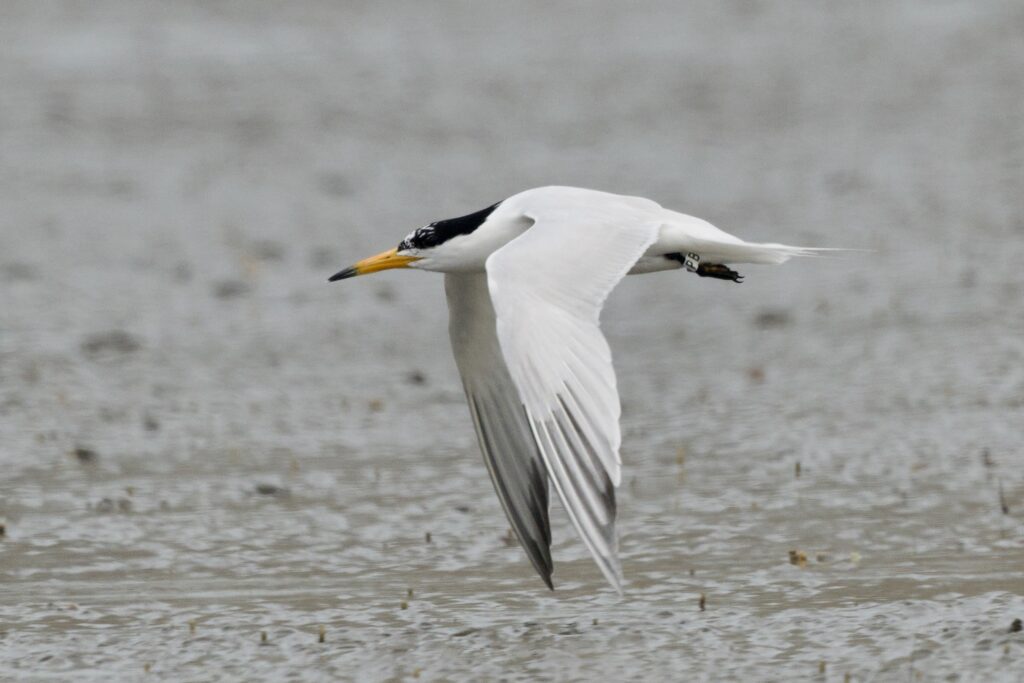
We were ecstatic that we were immediately successful on our first afternoon on 30 May as just over two hours before high water, at 14.41, as while we were walking back from the sea at area 3, a ghostly pale tern cruised up the main channel about 150 m away and I found myself shouting “There it is!” The bird landed on one of a series of long poles in the channel to preen, revealing that is was metal ringed on the right leg and sported a white ring with two letters, ‘PB’, on its left. ‘PB’ has been known since 2016 as the most productive male in the population, fathering all of the six successfully fledged chicks to 2024 (National Institute of Ecology 국 립 생 태 원 2024). Now, ‘PB’ had the beginnings of ‘receding hairline’ of white feathering across his forehead that can be shown by actively-breeding individuals later in the breeding season, or can be a sign of a move into non-breeding condition. Although we weren’t to know it at the time, but following information very kindly provided by Dr Kim Sung-Hyun (the report by National Institute of Ecology 국 립 생 태 원 2025), ‘PB’ had actually tried to breed in 2025 with ‘070’, his daughter from 2022. Unfortunately, the resultant chick from their pairing had died. Presumably, at the time we saw him, ‘PB’ was no longer restricted to ‘central place foraging’ around the colony, although may choose to attend at times, and was free to wander more widely. Now, after 21 minutes, PB flew back out to sea and north around the headland. Some 18 minutes later, we found ‘PB’ again on Gusipo beach preening and loafing amongst a group of Black-tailed Gulls Larus crassirostris 괭이갈매기 that proved to be omnipresent in/around Gusipo during our period of observation.
Needless to say, we were all incredibly excited at our sightings and the completion of Peter’s quest for his last seabird. He immediately recorded the following message:
“I’ve been seabirding ever since I was 6 years of age and it’s taken me almost 80 years to get to the point where I can say I’ve seen every single seabird in the world….with the appearance of the Chinese Crested Tern …everybody thought it was finished, it was gone, but it came back from the dark abyss of extinction….and we’ve just spent two, three days getting here, 6,500 to 8,000 miles depending on where we came from.…and it was my good friend, Martin Perrow, the editor and also co-author of seabirds that called it out…and I’ve got to say…. Oh… fantastic my friend, it was just fantastic”.
There was not a dry eye on that beach on the culmination of a dream.

The focus of our quest now shifted to increase the number of sightings and try to understand a bit more about the birds. The following summarises our observations including dates, times, including relative to tidal cycle (HW = High Water and LW = Low Water), and notes on behaviour:
- 31 May. Gusipo Beach (site 2). 08.25. 2 hrs 41 mins after HW or 3 hrs 57 mins before LW. CCT on shoreline and bathing in sea. After 2 mins later flew to freshwater seepage on middle of beach to preen amongst Black-tailed Gulls 괭이갈매기 that were also drinking and preening. Walked further down beach. Flew part way back after 24 mins (08.51). Individual with no rings (i.e. unbanded) and a complete black cap apart from a white spot above the left eye and a smaller white fleck on the crown only visible from some angles, especially head-on. Based on experience with similar, better known Thalasseus terns (e.g. Greater Crested T. bergii and Royal T. maxima – see e.g. Olsen & Larsson 1995), this spot along with darker smudgy markings in the worn secondaries alongside new inner primaries, aged the bird as a third-calendar year sub-adult i.e. born in 2022. The particularly large bill indicated a male, as did its confident strutting behaviour amongst the gulls while it called softly; with the larger larids warily conceding ground. But, the only known chick from the population in 2022 was the female 070 (National Institute of Ecology 2024, 2025). So, did this individual originate from an undocumented breeding attempt in ROK or was it born in China? After a further 4 mins, the bird flew further down the beach and we left.


- 31 May. Gusipo Beach (site 2). 10.41. 1 hr 41 mins before LW. On return, CCT present on wide expanse of muddy beach amongst scattered Black-tailed Gulls 괭이갈매기. CCT confirmed as ‘PB’ with telescope. Preened before roosting with head tucked into scapulars by 10.50. Asleep as clam harvesters walked past within 10 m or so. Human activity increased and ‘PB’ seemed to be disturbed, becoming restless before flying across the channel at 11.03 to sit on a distant breakwater by 11.05 for less than 2 minutes, as it was disturbed by an angler choosing to set up off the rocks. These behaviours made us wonder how many birders expecting CCT on the beach as is typically recorded by ebird, miss CCT perched on other structures.


- 1 June. Gusipo Beach (site 2). 08.35. 1 hr 3 mins after HW. Observed sitting quietly on beach with gulls in close proximity. Tern call, not dissimilar to ‘kerrick’ call of Sandwich Tern, heard initially from several hundred metres away to appearance of CCT in flight above beach. Landed relatively close by. Confirmed as unringed third-calendar year sub-adult seen previously, by details of white markings in otherwise complete black cap. Preens for around 7 mins before flying closer to the sea. Observer left quietly at 08.42 for another reported sighting of a pair together at another location.


- 1 June. Myeongsasimni (site 1). c.08.30. c.1 hr after HW. Pair observed by Dr Moores confirmed as known ringed male, ‘PA’, and unringed female. Relationship as a pair reinforced by behaviour, with short nearshore foraging trip leading to the capture of a fish that was presented by ‘PA’ to his mate in the manner of ‘courtship feeding’ back on the beach. Loafing Black-tailed Gulls 괭이갈매기 and a Far Eastern Oystercatcher 검은머리물떼새 present. After 43 minutes, the CCT pair left the beach and flew off in a northwesterly direction on a bearing of c.3280 in the direction of an offshore island. Lost to view at a distance of c. 1.5 km. Could there be other breeding sites (and even other birds) waiting to be discovered?

- 1 June. Myeongsasimni (site 1). 16.50. 1 hr 49 mins before HW. Individual seen foraging offshore, ultimately heads off on similar bearing to that taken by pair in earlier observation.
- 2 June. No sightings along beaches from 16.56 c. 2 hrs 37 mins before HW to 18.20 at 1 hr and 13 mins before HW.
- 3 June. No sightings from 08.11, 4 mins to HW to 09.49, 1 hr 34 mins after HW and then from 13.06, 1 hr 8 mins after LW.
- 3 June. Gusipo Beach (site 2). 18.26. 3 hrs 28 mins after LW (4 hrs and 9 mins before HW). ‘PB’ present amongst Black-tailed Gulls 괭이갈매기 concentrated in northerly part of beach near road, by much human activity on an extensive beach. Some preening behaviour. ‘PB’ retreats from human activity (walkers and clam collectors) and then flies further up beach from advancing tide. Engages in further preening. Walks away from human walkers. Further stretching. Tide gathers around his feet for second time. Retreats. With tide around feet for third time, stretches and then flies out to sea at 19.06.


4 June. No sightings at Gusipo Beach from 07.02, 2 hrs and 10 mins before HW to 07.59 1 hr and 13 mins before HW.
Concluding remarks
In the period 30 May to 4 June 2025, we observed 4 different individual CCT focussed on Gusipo Beach in the larger area from Myeongsasimni in the north to Goripo in the south. The individuals involved were the known ringed male, ‘PB’, the known ringed male ‘PA’ and his unringed mate, and what appears to be a previously undescribed individual. The latter bird was thought to be a male from bill morphology and behaviour and aged as in its third calendar year; thus born in 2022. The only chick fledged from the known ROK colony in 2022 was female and ringed, 070. The individual observed was thus either born in an undocumented site in ROK or from one of the colonies in the much larger population in China. It is a known phenomenon amongst several species of tern for younger individuals to prospect other colonies away from their natal colony, presumably with the intention to breed in future should conditions be favourable (see Dittmann et al. 2025, Ratcliffe et al. 2008, Cabot & Nisbet 2013, Redfern et al. 2026). One mechanism to allow individuals to reach distant and previously unknown colonies is through mixing and social interaction at stopovers at other times, with birds subsequently joining with groups or other individuals on migration. There is obvious potential for mixing of CCT from different colonies and subpopulations on the significant autumn concentration in Jiaozhou Bay in Qingdao.
Our observations support the findings of the National Institute of Ecology 국 립 생 태 원 (2025) that CCT may be seen into the summer period in and around Gusipo Beach. The notion that this would most likely involve non-breeding individuals is also suggested by our observations. The exception to this appears to be ‘PB’, in that the National Institute of Ecology 국 립 생 태 원 (2025) report that the breeding attempt involving ‘PB’ included the egg being laid by his mate on May 18 and then incubated for 30 days (i.e. to June 17) without hatching beyond the known incubation period of 26–28 days (Lee et al. 2021). So, ‘PB’ was actively breeding in the period our observations were made. But the level of commitment by ‘PB’ could be questioned, especially given that his mate, 070, was inexperienced and nesting for the first time. Although highly experienced, ‘PB’ is also of unknown age although is most likely at least 13 years (breeding since at least 2016 when he was likely at least 3 years of age) and possibly much older. Terns may live for at least 30 years and there is no current evidence for old age (senility) reducing breeding performance, although this seems possible. However, given that ‘PB’s former mate, K00, has now selected, and is regularly breeding with another male, K11 (National Institute of Ecology 국 립 생 태 원 2025), this could suggest that ‘PB’s’ powers as a breeding adult are beginning to fade.
The other pertinent question to be considered is what is the attraction of the Gusipo Beach area and surrounds for CCT? There is a suggestion the area is important as a roosting (i.e. resting or loafing including maintenance behaviours such as preening) and foraging area (National Institute of Ecology 국 립 생 태 원 2025). However, given that there has been no apparent systematic attempt to fully describe the habitat use of either non-breeding or especially breeding birds, the relative importance of the Gusipo Beach area can only be indicated as yet. The fact that birds can be regularly seen in the area provides little indication of how important the area is relative to other areas that are not surveyed, just that it is used. Certainly, the distance of 20 km from the main breeding colony at Yuksan Islet is likely to be well within foraging range of breeding adults, given the experiences with other terns (see Introduction above). It is however perhaps more unusual that terns breeding on offshore islands focus on waters closer to shore, although there are examples where this has occurred. This includes Roseate Tern 긴꼬리제비갈매기 at Coquet Island (Robertson et al. 2014), where inshore foraging was thought to be driven by interspecific competition, as both far more numerous (c. 14-fold), sympatrically nesting Common 제비갈매기 and Arctic Terns 북극제비갈매기 tended to dominate the waters around the breeding island. For CCT, without an understanding of the habitat requirements of their main prey for example, it may prove to be that other areas are far more important as foraging grounds. Moreover, it is difficult to understand the attraction of Gusipo Beach itself especially since birds appear to be regularly disturbed, albeit unintentionally by humans, even though the individuals involved may be somewhat acclimatised and relatively tolerant of human presence. It could be that the omnipresent Black-tailed Gulls 괭이갈매기 offer vigilance and therefore some security from predators such as raptors, for lone birds in particular. Moreover, the seepage on the beach, seemed to be especially attractive and as it appears to be ‘freshwater’ (though perhaps from a human source) for drinking and bathing/preening may represent a relatively rare commodity directly adjacent to the sea. The same may be said of both the other sites visited at Myeongsasimni and Goripo where watercourses discharge into the sea.
The means of determining habitat use of seabirds is currently often undertaken by some form of telemetry, with GPS tags directly connecting to receiving stations in the colony through bluetooth technology thereby negating the need to recapture birds, now widely adopted (see Thaxter & Perrow 2019). The issue is that although such methods have become popular for terns (see for example, Fijn et al. 2014, Seward et al. 2021, Thaxter et al. 2024) my own direct experiences with tagging terns (my team were the first to do so for both Little 쇠제비갈매기 and Sandwich Terns in the UK; Perrow et al. 2006, 2011, 2015) reveals that terns do not respond favourably to capture and handling (see Perrow et al. 2011, Seward et al. 2021) and do not carry tags easily, which has led to the trial of different attachment techniques (see Thaxter et al. 2024). Interrogation of the details of published studies reveals that the effects of tags may be serious enough to mean that the findings may be compromised. For example, Thaxter et al. (2024) showed very short periods of contact (means of 2 to 8 days in different years) with tagged birds, typically much shorter than the life of the tag battery or likely attachment time. Maximum trip duration in different years ranged from 9.5–33.5 hours (i.e. more than 1 day) with maximal foraging distances of 81–292 km, all far greater than the maxima of 3–4 hours and distances of up to 50–70 km expected from birds attending nests where they were captured and tagged. It would seem that many of the birds showing such patterns had failed in their breeding attempt. Although no details of the outcome of the breeding attempt are documented, the risk is that tagging was often the primary cause. Similar patterns were previously shown by Fijn et al. (2014), with one Sandwich Tern captured at the nest tracked a day later some 130 km away to a beach in a different country. This bird then flew back two days later at an incredible average speed of 91 km/hour. Several birds showed similar patterns with all labelled as displaying ‘prospecting’ behaviour. An alternative interpretation is that birds involved were so seriously affected by tagging to mean the breeding attempt was abandoned and the stressed birds flew as far away as possible in the first instance from the perceived threat.
For a species as rare as CCT, the potential risks of capture, handling and tagging to any individual and thus the very small population as a whole, would seem to be unacceptably high. This has precedence with Roseate Tern 긴꼬리제비갈매기 in the UK, where the far more numerous Arctic Tern 북극제비갈매기 was used as a proxy to trial tagging techniques (see Seward et al. 2021), and after detailed observations of tagged birds relative to controls revealed issues, then subsequent at-sea tracking was undertaken with the non-invasive visual tracking (see Perrow et al. 2019). Further work in subsequent years was then undertaken and a further offshore protected area proposed that includes Roseate Tern 긴꼬리제비갈매기 amongst multiple other seabird species (NPWS 2023). The latter was partly in response to the potential threats of proposed offshore wind farms to the major colony for Roseate Tern 긴꼬리제비갈매기, not only in Great Britain & Ireland, but also in European waters.
In my humble opinion, a great deal of fundamental critical information such as habitat use, foraging behaviour, prey selection of adults relative to chick provisions and potential risks of future wind farm development, coupled with the basis to define offshore protected areas for CCT may be gathered by visual tracking of breeding CCT, and perhaps of non-breeding birds flying out to sea from the Gusipo area. If this is undertaken however, careful consideration must be given to the size, power and manoeuvrability of the RIB involved so this is optimal for the sea conditions and to ensure the quality of information gathered as well as proportion of complete tracks is as high as possible.
Returning to the question of the threat of existing wind farms offshore of the Gusipo area and of any future planned sites, I would make the following points from personal experience of extensive studies on terns interacting with wind farms over >20 years in the UK and of considerable research of the effects and solutions to those effects of offshore wind farms more generally (Perrow 2019abc). As a fundamental stating point, offshore wind farms change virtually every aspect of the marine environment beginning with atmospheric conditions and ocean dynamics changing patterns of upwelling and downwelling influencing trophic dynamics and ultimately the abundance, distribution and assemblages of plankton, fish, seabirds and marine mammals (Perrow 2019abc). The hard substrates associated with ‘fixed’ wind, where turbines are supported on monopiles or jacket foundations are colonised by sessile fauna such as mussels, anemones or corals depending on location that may not be typical of the surrounding seabed and the entire ecological structure, interactions and functions within the food web changes accordingly. One typical effect is that large predatory fish associate with what become artificial ‘reefs’. The small, pelagic forage fish that are eaten by these fish as well as terns and other seabirds may be disfavoured and displaced.
At a particularly well monitored site in the UK we monitored by boat-based surveys and visual tracking (see Introduction above) Sandwich Terns reduced their use of the wind farm area by between 32%–44% in the different years of operation (see Jones et al. 2024). The individuals that did enter the site generally took flightlines equidistant between turbines clearly suggesting they were aware of the distances involved and therefore typically actively avoided the turbines, let alone entering the rotor swept area of those turbines. The observed avoidance rate was therefore 100%, with a precautionary avoidance rate calculated from change in behavioural responses before and after construction of turbines calculated as a minimum of 98.86%. Moreover, those birds that did enter the site significantly reduced foraging activity to around 60%of that recorded outside the wind farm,when this was identical before the wind farm was built was built. It is unknown if ‘fear’ of turbines meant that terns were less willing to feed or that there were fewer suitable prey fish present, or that a combination of both factors was responsible for the patterns observed.
We can only speculate what the effects of current and future wind turbines within the foraging range of CCT are, or will be, although these may be considerable leading to an impact on individual fitness and the prospects of survival. However, what is clear is that for such a small population, an impact leading to the loss of even a single individual is critical. This magnifies the need for as much understanding as possible through a detailed research programme utilising and building upon the lessons learned in western Europe in particular, which is currently a hub of knowledge and information.
In relation to the point that the loss of even a single individual CCT would represent a significant impact at the population level, it is a cause of concern that female 070 seems to be the first known chick to recruit into the adult population by attempting to breed, albeit unsuccessfully, in 2025 in its third calendar year. The question is did the other 5 chicks fledged by 2024 not survive? Or have they ultimately nested elsewhere, either in ROK or in the larger population in China through the mechanisms outlined above. Whatever is the case, the lack of obvious recruitment brings into perspective that the tiny ROK population is not growing. Any possible threat at any life stage therefore needs to be very carefully considered and potentially managed. On the principle nesting island, Yuksan Islet, the detailed work of the National Institute of Ecology (2024, 2025) reveals the presence of two invasive species; Kudzu Pueraria montana, one of the world’s most invasive plants, and Brown Rat Rattus norvegicus, one of the world’s most invasive mammals.
In relation to the latter, accidentally introduced rats of various species are known to be one of the most significant threats to breeding seabirds on islands, summarised in the review by Towns et al. (2011) as “earlier analyses pointed to Norway [Brown] rats as the most destructive of the rat species for seabirds…., which indicates that all three rat species [meaning Black or Ship Rat Rattus rattus, Pacific Rat R. exulans and Norway or Brown Rat R. norvegicus] can have devastating effects, depending on circumstances…”. In general, rats are perceived to exert the greatest effects on small burrow-nesting seabird species, with the largest surface-nesting species being least affected, and that eggs and chicks are targeted over adults. However, general trends are hard to establish as there are now examples of seabirds nesting in all habitats, including trees being affected and even the largest seabirds (e.g. the great albatrosses Diomedea spp.) being attacked by rodents. Moreover, the actual effects of rodents (e.g. through dietary studies) relative to other factors are hard to determine before any attempt at rat eradication, with the results after the event producing the most compelling evidence of a ‘hidden’ effect. The review of Towns et al. (2011) records many positive responses amongst seabirds that may not have been the obvious target for rat removal, including cliff-nesting species such as Northern Fulmar Fulmarus glacialis, Razorbill Alca torda and European Shag Gulosus aristotelis, as well as surface nesting species including Bridled Tern Onychoprion anaethetus 에위니아제비갈매기 on Hardy Island in the West Indies. With a highly endangered species such as CCT, every egg laid and every chick hatched becomes critical, and as such, the ‘precautionary principle’ in relation to potential predators is best adopted. Indeed, the eradication of rats from Tiedun Dao, the initial focus of the CCT conservation strategy in China was seen as a fundamental first step to securing successful breeding and population expansion on the island (Lu et al. 2020), providing a sound basis for a similar strategy in ROK.
It is also understood that Kudzu was expanding on both the main and supplementary breeding islands (National Institute of Ecology 2025), with monitoring of this situation to be continued. However, the rapid growth rate of this plant means that it can quickly reach proportions that make it challenging and expensive to control. As with many invasive plants, early intervention is often seen as the best strategy. For Kudzu, cutting and treatment with herbicide in the late summer (i.e. after CCT has completed its breeding cycle) would seem to be a good option.
Having had the pleasure of spending a short time in the western part of ROK amongst its special birdlife and especially CCT, one of the most magnificent and intriguing tern species I have encountered in my travels, I now sincerely hope and pray for the continued long life of the individuals in the tiny population and all powers possible to the conservation authorities to give CCT the best chance possible to flourish and ultimately reclaim all likely breeding grounds across the mighty Yellow Sea.
Acknowledgements
Grateful thanks to Dr Kim Sung-Hyun for providing information from the National Institute of Ecology 국 립 생 태 원, without which this post would have been greatly diminished. On behalf of my friends and colleagues, Peter Harrison MBE and Jonathan Roussow as well as myself, we remain indebted to the expertise of Dr Nial Moores and Prof Young-gul Kim representatives of Birds Korea for skilfully enabling our special shared experiences with Chinese Crested Tern, a truly iconic, ‘mythical last seabird’. Thanks also to Dr Moores for inviting me to contribute this blogpost. I hope it stimulates further interest in the continued conservation of the species, particularly in ROK, and I remain available to assist in whatever way possible.
References
Cabot, D. & Nisbet, I. (2013). Terns. The New Naturalist Library, Collins: 461pp.
Caldow, R.W.G., Perrow, M.R., Allen, D., Black, J., Bond, I., Harwood, A.J.P., Liley, D., McCullough, N., Murphy, M., Win, I. & Yates, L. (2020). Chapter 28. Verifying predictions of statistical models to define the size and shape of marine Special Protection Areas for foraging seabirds (terns). In: Humphreys, J. & Clark, R.W.E. (eds) Marine Protected Areas: Science, Policy and Management. Elsevier, Amsterdam, Netherlands: pp. 543–572.
Chan, S. (2024). Migratory birds: Successes in the last 30 years and new challenges. Presentation at theWorkshop on Nature Conservation and Biodiversity for Transboundary Cooperation. 28-29 August 2024. Incheon, Republic of Korea. Available at https://www.neaspec.org/sites/default/files/2024-11/Session%202.1%20%28MB%29%206.%20Simba%20Chan.pdf
Chan, S., Chen, S.H. & Yuan, H.W. (2010). International Single Species Action Plan for the Conservation of the Chinese Crested Tern (Sterna bernsteini ). BirdLife International Asia Division, Tokyo, Japan; CMS Secretariat, Bonn, Germany.
Dittmann, T., Zinsmeister, D., Becker, P.H. (2005). Dispersal decisions: common terns, Sterna hirundo, choose between colonies duringprospecting. Animal Behaviour 70(1): 13-20.
Harwood, A.J.P., Perrow, M.R., Berridge, R., Tomlinson, M.L. & Skeate, E.R. (2017). Unforeseen responses of a breeding seabird to the construction of an offshore wind farm. In: Köppel, J. (ed). Conference on Wind Energy and Wildlife Interactions Presentations from the CWW2015 conference. Springer International Publishing. pp. 19–41. ISBN 978-3-319-51270-9.
Jones, E.L., Hague, A., Skeate, E.R., Perrow, M.R., Searle, K.R., Scott-Hayward, L.A., Couto, A., Daunt, F., Miller, S., Delacombe, K., Wooldridge, T. & Butler, A. (2025). Synthesis of Evidence -Closing the Loop: Feasibility study to determine a feedback approach for post-consent monitoring to reduce consenting risk in future assessments. BioSS/The James Hutton Institute, 2025.
Lee, Y., Kim, W., Kang, J., Yoo, S.-Y., Cha, H.-G., Lee, S.-Y. & No, D. (2021). 한국의 뿔제비갈매기(Thalasseus bernsteini) 도래 시기와 번식 현황 Arrival and breeding status of the Chinese Crested Tern (Thalasseus bernsteini) in Korea. Korean Journal of Ornithology 28(2): 66-74.
Liang, C.-T., Chang S.-H. & Fang, W.-H. (2000) Little known oriental bird: Discovery of a breeding colony of Chinese Crested Tern. Oriental Bird Club Bulletin 32: 1819.
Liu, Y.C. & Hetherington, W. (2016). Rare terns spotted around Penghu. Available here
Lu, Y.W., Roby, D.D., Fan, Z.Y., Chan, S., Lyons, D.E., Hong, C.-H., Wang, S., Yang, J., Zhou, X., Chen, D., Yuan, H.-W. & Chen, S. (2020). Creating a conservation network: Restoration of the critically endangered Chinese crested tern using social attraction. Biological Conservation 248: 108694.
Moores, N. (2023). The Chinese Crested Tern 뿔제비갈매기 in Korea. Birds Korea Blog. April 2nd 2023. Available at https://www.birdskoreablog.org/?p=27008
National Institute of Ecology 국 립 생 태 원 (2024).국 제 적 멸 종 위 기 종 뿔 제 비 갈 매 기 번 식 생 태 및 서 식 지 연 구 ( 3 차 년 도 ) Breeding ecology and habitat characteristics of the Chinese Crested Tern, Critically Endangered Species. 연 구 보 고 서 ( 연 차 NIE-B-2024-13: 108pp.
National Institute of Ecology 국 립 생 태 원 (2025). 국 제 적 멸 종 위 기 종 불 제 비 갈 매 기 번 식 생 태 및 서 식 지 연 구 ( 4 차 년 도 ) Breeding ecology and habitat characteristics of the Chinese Crested Tern, Critically Endangered Species. 연 구 보 고 서 ( 연 차) NIE-B-2025-13: 126pp.
National Parks and Wildlife Service (NPWS) (2023). Conservation Objectives: North-west Irish Sea SPA 004236.
Version 1. National Parks and Wildlife Service, Department of Housing, Local Government and Heritage: 45pp. Available at https://www.npws.ie/protected-sites/spa/004236
Olsen, K.-M. & Larsson, H. (1995). Terns of Europe and North America. Princeton University Press: 207pp.
Perrow, M.R. (ed) (2017a). Wildlife and Wind Farms, Conflicts and Solutions Volume 1 Onshore: Potential Effects. Pelagic Publishing, Exeter, UK: 289pp.
Perrow, M.R. (ed) (2017b). Wildlife and Wind Farms, Conflicts and Solutions Volume 2 Onshore: Monitoring and Mitigation. Pelagic Publishing, Exeter, UK: 217pp.
Perrow, M.R. (ed) (2019a). Wildlife and Wind Farms, Conflicts and Solutions Volume 3 Offshore: Potential Effects. Pelagic Publishing, Exeter, UK: 291pp.
Perrow, M.R. (ed) (2019b). Wildlife and Wind Farms, Conflicts and Solutions Volume 4 Offshore: Monitoring and Mitigation. Pelagic Publishing, Exeter, UK: 330pp.
Perrow, M.R. (2019c). A synthesis of effects and impacts. In Perrow, M.R. (ed). Wildlife and Wind Farms, Conflicts and Solutions Volume 3 Offshore: Potential Effects. Pelagic Publishing, Exeter, UK: pp. 235–277. In: Perrow, M.R. (ed). Wildlife and Wind Farms, Conflicts and Solutions Volume 4 Offshore: Monitoring and Mitigation. Pelagic Publishing, Exeter, UK: pp. 96–134.
Perrow, M.R., Skeate, E.R. & Gilroy, J.J. (2011). Novel use of visual tracking from a rigid-hulled inflatable boat (RIB) to determine foraging movements of breeding terns. Journal of Field Ornithology 82: 68–79.
Perrow, M.R., Harwood, A.J.P, Berridge, R.J. & Skeate, E.R. (2017). The foraging ecology of Sandwich Terns in north Norfolk. British Birds 110: 257-277.
Perrow, M.R., Gilroy, J.J, Skeate, E.R. & Mackenzie, A. (2010). Quantifying the relative use of coastal waters by breeding terns: towards effective tools for planning and assessing the ornithological impacts of offshore wind farms. ECON Ecological Consultancy Ltd. Report to COWRIE Ltd. ISBN: 978-0-9565843-3-5. Available from: http://www.thecrownestate.co.uk/media/5999/cowrie-quantifying-the-relative-use-of-coastal-waters-by-breeding-terns.pdf
Perrow, M.R., Skeate, E.R., Lines, P., Brown, D. & Tomlinson, M.L. (2006). Radio telemetry as a tool for impact assessment of wind farms: the case of Little Terns Sterna albifrons at Scroby Sands, Norfolk, UK. Ibis: 148 (Suppl. 1): 57-75.
Perrow, M.R., Harwood, A.J.P., Skeate, E.R., Praca, E. & Eglington, S.M. (2015). Use of multiple data sources and analytical approaches to derive a marine protected area for a breeding seabird. Biological Conservation 191: 729–738.
Perrow, M.R., Harwood, A.J.P, Berridge, R.J, Burke, B. Newton, S. & Piec, D. (2019). Foraging and chick-provisioning ecology of Roseate Terns breeding at Rockabill, in Ireland. British Birds 112: 496–516.
Ratcliffe, N., Newton, S., Morrison, P., Merne, O., Cadwallender, T. & Frederiksen, M. (2008). Adult survival and breeding dispersal of Roseate Terns within the Northwest European metapopulation. Waterbirds 31(3): 320-329.
Redfern, C.P.F., Steel, D. & Morrison, P.G. (2026). Natal philopatry, dispersal and age of first breeding in relation to size and sex of Arctic Terns (Sterna paradisaea). Ibis 168: 79–94.
Robertson, G.S., Bolton, M., Grecian, W.J., Wilson, L.J., Davies, W. & Monaghan, P. (2014) Resource partitioning in three congeneric sympatrically breeding seabirds: foraging areas and prey utilization. The Auk 131(3): 434-446.
Seward, A., Taylor, R.C., Perrow, M.R., Berridge, R.J., Bowgen, K.M., Dodd, S., Johnstone, I. & Bolton, M. (2021). Effect of GPS tagging on behaviour and marine distribution of breeding Arctic Terns Sterna paradisaea. Ibis 163: 197–212.
Song, S.-K., Lee, S.W, Lee, Y.K., Lee, S.Y., Kim, C.H., Choi, S.S., Shin, H.C., Park, J.Y., Lee, J.H., & Kim W.-Y. (2017). First report and breeding record of the Chinese Crested Tern Thalasseus bernsteini on the Korean Peninsula. Journal of Asia-Pacific Biodiversity 10: 250–253.
Thaxter, C.B. & Perrow, M.R. (2019). Chapter 4. Telemetry and tracking of birds. In: Perrow, M.R. (ed). Wildlife and Wind Farms, Conflicts and Solutions Volume 4 Offshore: Monitoring and Mitigation. Pelagic Publishing, Exeter, UK: pp. 96–134.
Thaxter, C.B., Green, R.M.W., Collier, M.P., Taylor, R.C., Middelveld, R.P., Scragg, E.S., Wright, L.J., Cook, A.S.C.P. & Fijn, R.C. (2024). Behavioural responses of Sandwich terns following the construction of offshore wind farms. Marine Biology 171:58.
Towns, D.R., Byrd, G.V., Jones, H.P., Rauzon, M.J., Russell, J.C. & Wilcox, C. (2011). Impacts of introduced predators on seabirds. In: Mulder, C.P.H., Anderson, W.B., Towns, D.R. & Bellingham, P.J. Seabird islands: Ecology, Invasion and Restoration. Oxford University Press, UK: pp. 56–90.
Yang, J., Chen, G., Yuan, L., Huang, Q., Fan, Z., Lu, Y., Liu, Y. & Chen, S. (2018). Genetic evidence of hybridization of the world’s most endangered tern, the Chinese Crested Tern Thalasseus bernsteini. Ibis 160: 900–906.
Wang, S., Ding, P., Lu, Y., Zhou, X., Yan, Z., Qiana, C. & He, K. & Fan, Z. (2026). Decadal banding efforts pay off: Assessing Chinese Crested Tern conservation through resighting data. Avian Research 17: 100329.
Wilson L. J., Black J., Brewer, M. J., Potts, J. M., Kuepfer, A., Win I., Kober K., Bingham C., Mavor R. & Webb A. (2014). Quantifying usage of the marine environment by terns Sterna sp. around their breeding colony SPAs, JNCC Report 500, ISSN 0963 8901.