
“Strength in Numbers!”
Birds Korea is dedicated to the conservation of birds and their habitats in Korea and the wider Yellow Sea Eco-region.
Founded in 2004, we are a legally-registered and award-winning Korean conservation NGO that depends entirely on project funds, donations, volunteers and active members to continue our work. Please join us, and please use your membership to get involved…
We are small and there is always so much to do. Membership can mean growing your own skill set while supporting conservation. We always need people who can help support and grow the work – people who love the social side of birding to help organise meetings and field-days and fund-raising events; young scientists willing to write posts, attend meetings and join fieldwork; students, teachers and parents with a passion for environmental education; and people with technical or financial skills who can help us to expand our online presence.
At the time of writing (in 2026) we have 300 members throughout Korea and around the world and a small office in Busan:
Birds Korea, 115-407 Ho, Daeyeon Hillstate Prugio, Su-Young Ro 345,Nam-gu, Busan 48432
Office Telephone: 051 627 3163
We also have a local, highly-active branch in Yeoncheon.
Thanks to the support of our members, supporters and friends we can get heard; we can influence decisions; we can win.
We conduct research; we work to solve issues through planning and design; and we do as much as our capacity allows to raise awareness and to support education programs. We are always open to collaboration with those of good mind – and are grateful for every opportunity to improve conservation opportunities as part of genuinely sustainable development.
Joining is easy: monthly membership is only 10,000 Korean won / month (though some of our members kindly provide 20,000 or even 30,000 a month) best through bank transfer to:
Park Sun-Ae (Birds Korea)
Account Number: 563401-01-117087, Kookmin Bank
Swift Code: CZNBKRSE
After tax, all membership money is used for maintaining our office; and supporting projects (helping to cover expenses or buying equipment). None goes to salaries or “perks”.
In 2025, our work included:
- Throughout the year, continuing our long-term conservation work in the Yeoncheon Imjin River Biosphere Reserve, with financial support from Yeoncheon County, Gyeonggi Province and a small grant from the EAAFP. As part of this, we continued to monitor cranes in the CCZ and Scaly-sided Mergansers within the Yeoncheon Imjin River Flyway Network Site; we gathered more data on Long-billed Plovers; and we surveyed multiple areas, with the aim of improving understanding of the distribution of birds and additional biodiversity. As in previous years, we then used this year’s research to propose restoration concepts and five key recommendations, which have been submitted to Yeoncheon County and Gyeonggi Province. English and Korean editions of our report on this work will be available on request to Birds Korea members. Also funded by Yeoncheon County and Gyeonggi Province, Birds Korea Yeoncheon also conducted several education programs, published a second small photo-guide; and with school students helped in the design of a signboard on Scaly-sided Mergansers which has now been erected in the Biosphere Reserve;
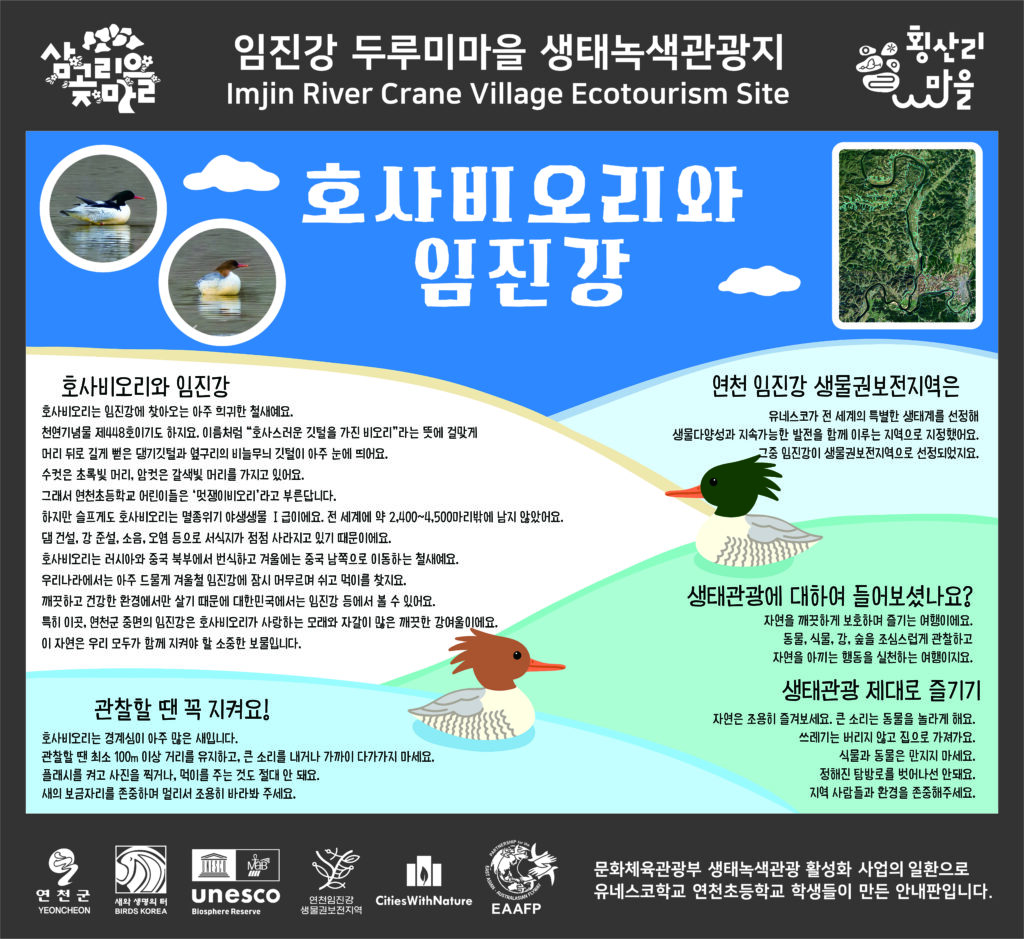
2. In Busan, starting a Society for Ecological Restoration-Microsoft supported collaborative pilot restoration project being developed through our MOU with the Busan Nakdong River Project Management Office. This active collaboration includes experts at the Nakdong Estuary Eco-centre; the company Land Aura; vegetation restoration specialists in a team led by Professor Byun Chaeho; 새덕후 Korean Birder; and various Birds Koreans, including Dr Kim Su-Kyung and Professor Amael Borzee in addition to Dr Nial Moores and National Coordinator Park Meena. This pilot project aims to help restore habitat of Eastern Taiga Bean Geese along the Nakdong River while trying to reduce the bird strike risk to aircraft flying in and out of the airport in Gimhae. The restoration work itself will start in 2026 with a field used for artificial feeding of geese in Maekdo Ecopark.

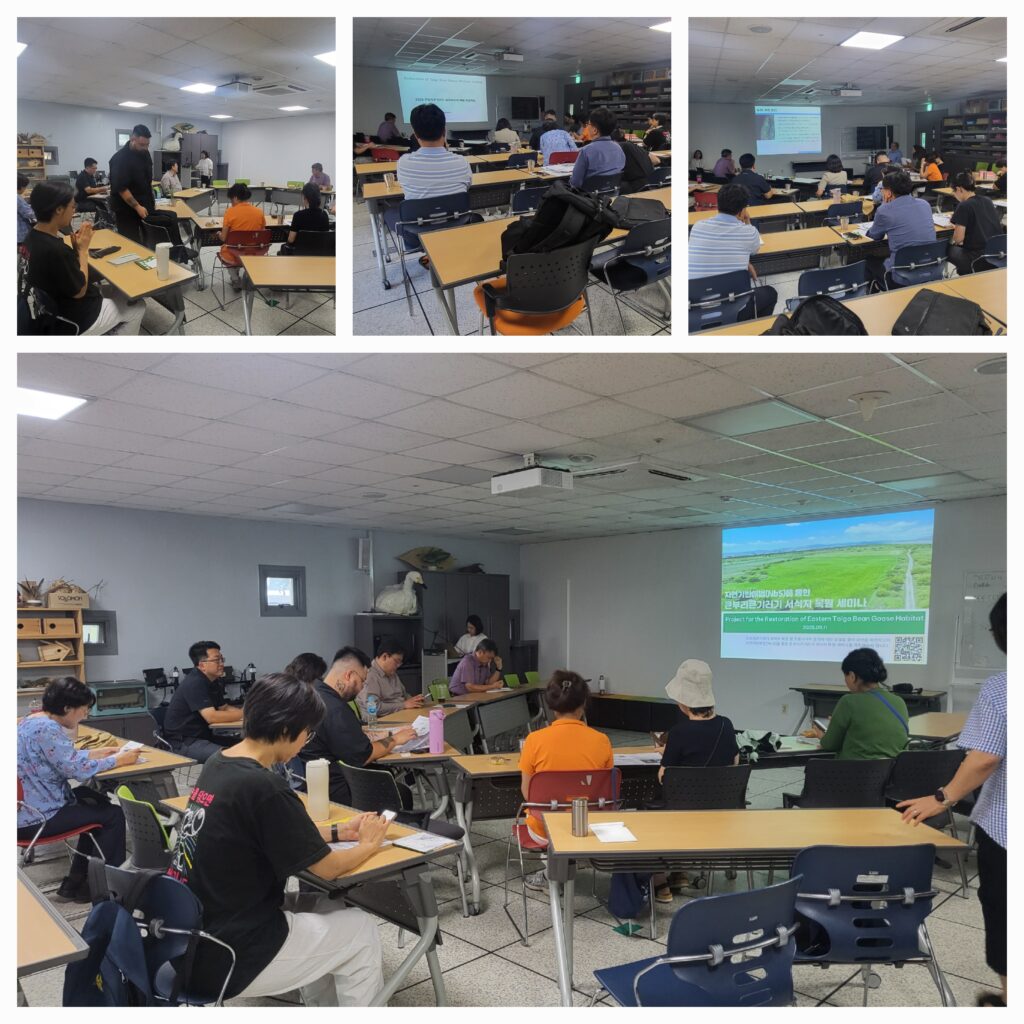
3. In spring and autumn, continuing research on bird migration hotspot Baengnyeong Island, where 400 species of bird have now been recorded since 2013;
4. In the summer, providing advice through a private company to a local government on ways to reduce the unintended negative impacts of proposed site management on birds within a designated Flyway Network Site;
5. In August, several members helping to assess the response of shorebirds and additional threatened waterbird species to the so-called “blue carbon” seawalls built across the tidal flat within what is supposed to be the strictly-protected Hwaseong Maehyangri Tidal Flat Wetland Protected Area in Gyeonggi Province. Our research found that many species of shorebird tried to avoid the seawall, reducing time available to e.g., globally Endangered Far Eastern Curlew for foraging and for roosting on the tidal flat;
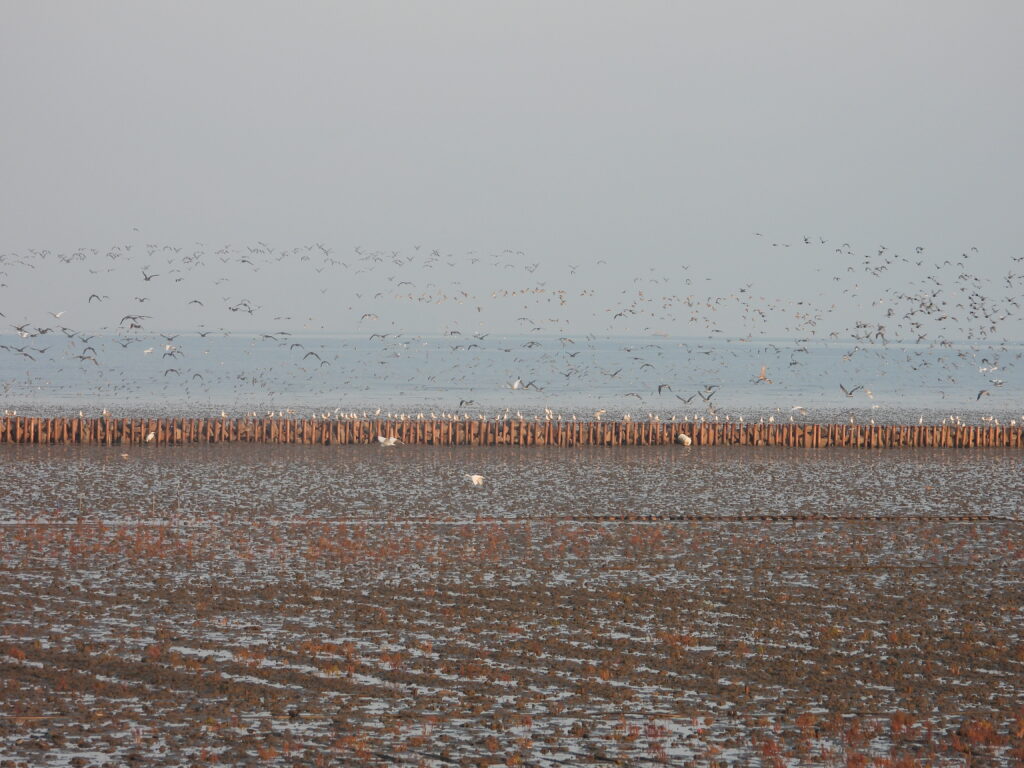
6. In October, helping to facilitate a national and regional eBird meeting in Incheon, which resulted in the evolution of a much larger South Korea eBird team headed up by Dr Jungmoon Ha;

7. And throughout the year, taking an active role in calling for much greater research to assess the bird-strike risk at airports, including newly proposed airports inside or within 8km of internationally important wetlands. In addition to submitting an opinion and expert testimony to the court case on Saemangeum New Airport in 2024, we also conducted fixed point counts at the proposed Gadeokdo International Airport in Busan with the results highlighted in an opinion submitted to the court. As posted on our blog,“90 hours of visible migration counts over 16 dates in Daehang, Gadeokdo, Busan, this September (2025) resulted in 12,837 -17,117 individual birds counted, with the five most numerous species Chinese Sparrowhawk Tachyspiza soloensis 붉은배새매 (7,604-11,046); Pacific (Fork-tailed) Swift Apus pacificus 칼새 (1,648-1,907); White-throated Needletail Hirundapus caudacutus 바늘꼬리칼새 (757-957); “Large White-headed Gulls” (1,330); and Black-tailed Gull Larus crassirostris 괭이갈매기 (650-700).” The scale of bird migration through this proposed airport site, at closest within 6km or so of the strictly protected Nakdong Estuary, was captured beautifully by Korean Birder새덕후, Korea’s leading wildlife YouTuber.
In addition to signing an MOUs with the Busan Nakdong River Project Management Office in 2025, Dr Nial Moores (National Director of Birds Korea) was recognised as an honorary citizen of Yeoncheon County for our conservation work there. Birds Korea also has an MOU with Incheon KFEM (signed in 2024) and with the Hanns Seidel Foundation Korea; and has won several awards for our conservation work.


To learn more about joining Birds Korea and to offer your support, please contact us directly.
By phone:
National Coordinator / Birds Korea Office, Ms Park Meena (Korean or English; Korean preferred) 051 627 3163
Director, Dr Nial Moores (English or Korean; English preferred),
(82) 010 9303 1963
By email:
ParkdotMeena at birdskorea.org;
NialdotMoores at birdskorea.org
or by mailing us below:
Comments or questions are welcome.